Delenda Est Carthago

Why not delve into a twisted mind? Thoughts on the world, history, politics, entertainment, comics, and why all shall call me master!

Name:
Location: Mesa, Arizona, United States

I plan on being the supreme dictator of the country, if not the world. Therefore, you might want to stay on my good side. Just a hint: ABBA rules!

24.9.09

Why didn't I love Inglourious Basterds?


I saw Quentin Tarantino's newest movie last week. I enjoyed the hell out of it. Really. But it was kind of like junk food, wasn't it?

I got in a bit of an argument with the guy at my comic book store about this. I told him that after we saw Inglourious Basterds, I couldn't figure out what the point was. He told me it didn't need a point. But I disagree! Yes, this is America! Disagreement is the spice of life!

Let me start by saying that I really enjoyed it. I just wrote it above, didn't I? Tarantino certainly knows how to put a movie together, and he's dynamite with actors. He often gets career-best performances out of actors. Brad Pitt is fantastic and funny, Mélanie Laurent is hard-ass and steely, Diane Kruger is wonderfully glamorous, and the Basterds themselves are excellent. Christoph Waltz is getting all the Oscar talk, and he's astonishing as Colonel Hans Landa, the "Jew Hunter." He's amazingly evil and refreshingly civil, except when, stunningly, he's not. The opening scene, when he shows up at a Frenchman's farm looking for a Jewish family, is one of the tensest scenes Tarantino has come up with in years. Waltz does a wonderful job with this utter opportunist, who does his job well but isn't above getting something for himself. Tarantino, naturally, comes up with some excellent action (a Mexican stand-off? in a Tarantino film? you don't say!) and sudden and shocking violence, and he reaches into his usual bag of tricks to twist the narrative around a bit - not as well as he's done in the past, but he's still a very good filmmaker. The grand finale is a wonderful orgy of violence and sly humor, and the final scene is a nice touch. Plus, Mike Myers is hilarious in his brief scene.

So what's my problem? Why can't I love this movie? Well, as I wrote, it's junk food. I couldn't quite figure out why Tarantino made this movie and what he's trying to say. My friend said it doesn't matter, that I should just enjoy it for the entertainment. However, I said that Tarantino has been making movies for almost 20 years, and he hasn't made one with something interesting to say since Jackie Brown, which came out in 1997 (granted, he's only directed two movies in between that one and this one, but still). We know he can make dazzling technical movies and that he can get excellent work out of his actors. Can he do anything else?

Getting back to Inglourious Basterds (and yes, I'm going to SPOIL it, so read no further if you really want to see it clean): What's Tarantino really trying to say? Ultimately, this is Death Wish with better financing and better acting. It's a revenge fantasy, and while I don't have an issue with revenge fantasies per se, Tarantino's last big movie, Kill Bill, was also a revenge fantasy. Revenge obviously plays a big role in all of his movies, to the degree that he's almost pathological about it, but does it need to be the driving force of this movie? We've heard the objections to the movie, about how it distorts history and is therefore disrespectful to Jews, because Tarantino's belief that killing Hitler somehow makes up for the millions slaughtered by the Nazis. I didn't get that - this is like a lot of old-time World War II movies, in which the Holocaust is virtually ignored because it gets in the way of a good action movie. Sure, Tarantino can make an action movie set in World War II in which he gleefully kills the Nazi High Command - I don't have a problem with that. I guess my objection is more with the tone of the movie. Tarantino seems to be far too gleeful about this movie, and it jars with the somewhat serious tone the movie has for a good deal of it. I wasn't particularly uncomfortable with Brad Pitt being a cheery psychopath, for instance - his attitude seems to be the one you need in a horrible war. It just seems like Tarantino, for all his gifts as a filmmaker, simply wants to revel in what he can do instead of trying for something more. If we look at someone like Scorsese, for instance, as an example of someone who has always resisted stereotyping. We might think of him as a director who makes bleak movies often starring Italian-American New York gangsters, but he's made a lot of different kinds of movies - he made The Age of Innocence, The Last Temptation of Christ, After Hours, The Last Waltz, and Alice Doesn't Live Here Anymore, for crying out loud. Scorsese is a great director because he doesn't let himself get pigeonholed. Tarantino, it seems, pigeonholes himself.

I suppose I'm not explaining myself very well. Tarantino is a gifted filmmaker, but he's content to mine the movies he saw in his childhood for inspiration and simply update things with tongue in cheek. Inglourious Basterds is a "remake" of an old Italian movie, for instance. I assume that Tarantino has seen the great World War II movies of the 1960s and 1970s, because that's when he was growing up. But even those movies took the war seriously, even if they had some humor. Tarantino takes nothing seriously, apparently, and because he doesn't make straight comedies, he usually falls short of greatness because of this. At least that's what I think. Maybe I'm not getting it across very well. Sorry!

Anyway, Inglourious Basterds is a marvelous movie to watch. I just didn't get enough out of it. Oh well.

Labels: , , ,

1.9.09

What I've been reading

Easy Riders, Raging Bulls: How the Sex-Drugs-and-Rock 'N' Roll Generation Saved Hollywood by Peter Biskind. 1998, Simon and Schuster, 506 pages.

I'm not sure if I've mentioned before how much I like not only the thing, but how the thing is made, and therefore I love reading books about how, say, movies are made almost as much as the movie itself. So I was jazzed to read this book, which is about the seismic shift in Hollywood from the late 1960s to the late 1970s. In that decade, a slew of new directors changed the way movies were made and how they were perceived. Biskind's book is pretty fascinating, and it's amazing that it's so, mainly because I hated pretty much everyone in this book. Yes, hated!

It's not surprising to anyone that creative types in a highly competitive business are often evil, but it's strange that every creative type in this book, with one exception, comes off as a complete scumbag. That one exception is Steven Spielberg, and from what the people in the book say, that might be because he's not a true "artiste." But we'll get back to that! (I should point out that a lot of the women come off pretty well, but that might be because this time period was still notable for its sexism, despite the women's movement.)

Biskind begins in the mid-1960s, when Hollywood had become a bit staid and conservative and moviegoers were abandoning theaters in droves. Television had taken a huge chunk out of their audience, and the owners of the movie companies, all old men, some of whom from the earliest days of Hollywood, no longer had any idea how to connect to the younger audiences. Into this mess came a bunch of directors and producers (and, to a lesser extent, writers and actors) who had been influenced by French New Wave and even Americans like Orson Welles (who became, in the 1970s, a patron saint of these men, who loathed how he had been treated by Hollywood) and wanted to make movies in that vein for an American audience. Biskind begins with Bonnie and Clyde, which shattered the perceptions of what a gangster movie could be and made Warren Beatty one of the most powerful men in Hollywood. He follows that up with Dennis Hopper's Easy Riders, which made a boatload of money and pointed the way to low-budget movies that connected with the hippie generation. By the end of the 1960s, the New Hollywood was off and running and ready for the 1970s, one of the most creative eras in moviemaking ever.

Biskind tells the story in a sprawling thematic fashion, focusing on certain movies and individual directors, jumping back and forth in time to cover what he sees as the major signpost movies along the way. He covers the ones you'd expect - The Godfathers, Apocalypse Now, The French Connection, The Exorcist, The Last Picture Show, Mean Streets, Taxi Driver, Five Easy Pieces, M*A*S*H - and some you might not expect, such as those of Lucas and Spielberg. The book is really about the directors, as the 1970s were their Golden Age, so he gives us good character sketches of Hopper, Robert Altman, Bob Rafelson, Francis Ford Coppola, William Friedkin, Paul Schrader, Hal Ashby (whose death he sees as the symbolic end of the era), Peter Bogdanovich, Martin Scorsese, George Lucas, and Spielberg. He gets into the directors' battles over creative control with the heads of the studios, who had never been challenged before. As their movies made money, the directors were able to gain more and reach higher, and Biskind's prose is thrilling as he discusses this. It's astonishing that he makes the dirty business of making movies (I mean, come on, they're only movies) sound so noble.

Of course, this is a "rise and fall" story, so the directors overreach, as many of them began to believe that they could write and produce, cutting everyone out of the process. As more than a few observers point out, very few of them were true "auteurs," so they couldn't write a good script or produce a good movie, and when they started alienating everyone who could, they turned out horrible movies. It's interesting that one of the few American "auteurs," Woody Allen, gets barely a mention in this book (and that to point out that he was, in fact, an auteur), perhaps because he was able to make the kinds of movies that these complicated directors wanted to make, and therefore wasn't as interesting. One of the weaknesses of the book is that Biskind tends to ignore a lot of movies that were important in the 1970s (A Clockwork Orange comes to mind), but if we recognize that he's not necessarily writing a history of the movies but a history of a group of directors who, to one degree or another, self-destructed like Icarus, it becomes less egregious. As the directors spiral out of control, Biskind does a good job getting all the dirt on them (he notes when people disagree on facts, but it happens surprisingly little) and showing how horrible they really were. Hopper is insane, Coppola is megalomaniacal, Scorsese is paranoid, Bogdanovich is vain, Friedkin is mean, and they're all doing copious amounts of drugs that don't help. It seems that very few of them made great movies after they became powerful, and only when they were brought low could they reinvent themselves. Some, like Bogdanovich (and, to a lesser extent, Coppola), never recovered. Some, like Scorsese, recovered almost in spite of themselves. Biskind writes this as a Greek tragedy, which is fine, but because there are almost no likable characters, it's hard to care all that much. Biskind, along with his subjects, seem to have an elevated idea of what movies mean, and although I love movies, I recognize that there might - just might - be more important things in the world. These directors, it seems, took far too long to figure that out.

Perhaps that's why Spielberg, and to a lesser extent Lucas, come off relatively well in the book. Lucas is, like every other director in the book, a control freak, but he takes it to a new level. Biskind seems to share the other directors' dismissive attitude toward Lucas, but he's the only one who created an independent entity that was able to be profitable and compete with the major studios. Of course, capturing the zeitgeist with Star Wars helped, but it was only with the success of The Empire Strikes Back was Lucas able to strike out totally on his own. But Lucas still comes off a bit like the emperor in the Star Wars saga - hiding out in the shadows, cloaked in mystery, slowly retreating more and more from the world. Spielberg, on the other hand, seems to be the only one who recognizes what movies are, and even though he cheat on Amy Irving, she's so mean to him you almost can't blame him. Spielberg is also held up to scorn by the subjects of the book, but he's also the only one who seemed to escape a major flop (1941) almost unscathed. There's a nice undertone of jealousy throughout the book whenever Lucas and Spielberg come up, both by the author and by the subjects. It makes the book a bit more interesting.

Ultimately, Biskind is a bit too in love with the decade, but at least he wears his heart on his sleeve. Yes, a lot of the movies of the Eighties were soulless corporate products, but perhaps that's because the directors of the Seventies screwed up so badly. They allowed their budgets to bloat so that their movies weren't profitable anymore, and so big-budget directors who could deliver as many dollars as possible came into vogue. The directors became so obsessed with power that they shut down producers, writers, and even actors occasionally, so the studio heads began to see less of those people too and began looking for the big explosion instead of the major star. Biskind never addresses that perhaps it wasn't only Spielberg's genius of reading the audience that changed the movies, but also the the egos of the directors. That's really the tragedy of this book - that talented people were allowed to run riot and destroyed a system without really replacing it with anything. After a decade of rule, the directors ate themselves and the studios just moved back in. Coppola wanted to create an alternative studio, Lucas sort of did, but nobody seemed to have a plan about what to do once they stormed the gates. They looked around, saw all the loot, and just started seizing it for themselves. Biskind's book is a fascinating portrait of this crazy time, and it's worth checking out for all the behind-the-scenes stuff about the movies and the lives of these men, who drank, smoked, and snorted anything they could get their hands on, blithely cheated on women who had supported them, and went a bit nuts when they got the keys to the kingdom. It's a gripping read, and I'd like to check out the other books that Biskind has written about the movie industry.

Labels: , , ,

17.8.09

Hey! I can review first-run movies occasionally!


This past Friday, Mia was at school, and Norah was at pre-school for the entire day. The entire day!!!!! We want to get her ready for kindergarten, so we're sending her to pre-school for the whole day once a week. That means I had most of the entire day to myself (about 10.30 a.m. to 2.45 p.m.) and nothing to do, so I went to the movies! Yay!

I checked out District 9 because why not? It's a pretty good movie, and now I'll tell you why! Here's the story: In 1982, an alien spaceship appeared over Johannesburg, South Africa. The humans went inside and found that the aliens were more like refugees, with no leaders and no organization. So the humans created a refugee camp for them (called District 9) and stuck them there, partitioning them off from the rest of the world. Now it's 2010, and the humans have had enough - the aliens are scheduled to be sent to a new camp, 200 kilometers away from Johannesburg. Into this mess comes Wikus van der Merwe (Sharlto Copley), a bureaucrat of MNU, the corporation in charge of the shantytown where the aliens - derisively called "prawns" because they look like seafood - live. Wikus is tasked with getting the prawns to sign a waiver agreeing to the move - this section of the movie is weirdly humorous, as it's such a bureaucratic thing to do, even when you're dealing with aliens who don't sign their names (luckily, Wikus understands their language). As he moves through District 9, he comes across a hut where there's a strange vial that squirts out some strange black liquid. Before you know it, Wikus is becoming a prawn himself, and MNU wants to experiment on him, and he's ostracized from society in the same way the prawns are. Oh, the irony!

The movie quickly goes from social allegory/satire to action movie, which presents some problems, but not enough to ruin the movie, unless you're really into seeing a social allegory. Obviously, the director, Neill Blomkamp (a South African himself, hence the setting of the movie), is going for the apartheid parallel, but he doesn't go far enough with it. First of all, he never mentions that this situation existed in South Africa in the first place, leading me to believe this is some parallel reality world where it didn't exist (in 1982, of course, apartheid was still in full effect, so somebody might have mentioned it). He also gives us stereotypical Nigerians as villains in the movie, which made me a bit uncomfortable. The white villains are evil, sure, but they're just regular people. The Nigerians, with their witchcraft and cult of personality around their leader, seem as or more subhuman than the prawns themselves, which is odd. It's a weird choice for Blomkamp to make and somewhat undermines his idea of tolerance that underlies the movie. Of course, he doesn't want to push the apartheid parallel all that much because he's making an action movie, but it's still a strange thing to put in the movie and then ignore. Perhaps it would have been better to set it somewhere else other than South Africa so that the parallel wouldn't have been so obvious.

The "mockumentary" style Blomkamp employs for some of the movie works against him, too. He starts the movie this way, but quickly abandons it for long stretches before intermittently using it again. It's the same thing as the apartheid subtext - embrace it completely or ditch it. It doesn't seem possible to tell this story in a "mockumentary" style, and so when he breaks with that, it heightens the "movie-ness" of it even more, drawing us out of the story. I get what he was trying to do with the "mockumentary" style, as it adds a immediacy and also a claustrophobia as Wikus's life unravels, but it feels affected because he doesn't use it throughout. Again, I doubt if he could use it throughout, so it probably should have been abandoned.

Of course, I still enjoyed the movie. It's not great science fiction, mainly because Blomkamp is too concerned with making an action movie, but it's a good action movie, with far more on its mind than most. He gets a great performance from Copley, who begins as a weasel and really doesn't do too much to redeem himself. Even as he begins to change, he doesn't sympathize with the prawns all that much, convincing himself that if he change back, his wife will take him back (she won't) and all will forgiven (it won't). When he's confronted with a moral choice about helping the aliens or helping himself, he helps himself. It's a nice character arc, actually, because we probably wouldn't believe that Wikus would change so quickly. When he finally comes down on the "right" side (and of course he does), it's not necessarily because he completely sees the light, but because he decides it's the only thing he can do. Copley is very good in the role, which is interesting given it's his first movie (indeed, his first acting job).

District 9 is R-rated, and it earns it. The language, according to the rating, is "pervasive," which is as good a description as any. It's also very violent, as Blomkamp, when he decides to make this a complete action movie, shows that he can really do action well. The violence is sudden and devastating and extremely graphic, just as a warning. It's also very quick, as Blomkamp doesn't linger on the horror, in case you're wondering. Despite the fact that the turn toward action is a bit disappointing, at least Blomkamp does it very well!

I wanted District 9 to be a masterpiece, but I'm not surprised it wasn't, as it was made by a bunch of people with very little movie experience. What it is, however, is a fine action movie disguised as a science fiction movie with a conscience, and it certainly makes you think more than other summer action movies do. It's very gripping and tense, keeping you on the edge of your seat throughout ("We'll sell you the whole seat, but you'll only need the edge!!!!!!) and featuring some very fine performances. If there's any justice in the world, it portends big things for its star and its director. And it's a fine way to spend two hours during the dog days of summer!

And if you don't believe me, Nik has reviewed it too! You can trust Nik!

Labels: , , , , , ,

25.2.08

My one thought about the Academy Awards (with possible spoilers)

I saw only one film that was nominated for an Oscar this year, and that was No Country For Old Men. While it's a brilliant movie and I can't really argue with its awards, I will point out one thing that makes me think it's not as good as everyone says: The only reason Javier Bardem finds out about Josh Brolin (well, not Bardem, but his employers) is because Brolin goes back to the massacre site at least six hours later to take water to a guy whose guts had almost completely leaked out of his body the first time he saw him. Did Brolin really think the guy would still be alive? It's this act of monumental stupidity that alerts the bad guys to his presence. That and the fact that he should have taken the money out of the bag immediately, which is what any smart person would have done. Even though I loved the movie, all through it I kept wondering how someone as smart as Brolin proves himself to be could be that stupid. A guy I know who saw it says it was because of his sense of honor, but really - he was a soldier, so even if he made the guy a promise, he should have known that the guy was going to die real soon. Maybe if he had gone back immediately I would have bought it, but he waited quite a while. If something like this happens in a whimsical romantic comedy (not the exact situation, of course, because I doubt if there are many drug-related massacres in many whimsical romantic comedies, but I mean the absence of logic in the characters' actions), we call bullshit. Why does a serious movie get away with it?

That is all. It's still an unbelievably excellent movie. I wouldn't say it's really enjoyable, because it's so bleak, but it's riveting. I'm still dying to see There Will Be Blood, even though I hear it's even bleaker. That's how I like my movies, consarnit!

Labels: , ,

22.12.07

My dream

In my dream, there is silence. Across the land, entertainment venues are shut down. The writers have not gotten their just rewards, because the moguls do not want to release their miserly grip on any penny of their profits. And so the television shows, writerless, founder and sink, never to be seen again. Movie theaters are dark, their celluloid visions forever locked inside the minds of striking writers. But is there sadness throughout the land?

In my dream, there is no sadness. People writhed in agony without their fix of CSI, House, Pushing Daisies, and The Office. They were ecstatic when the late-night talk shows returned, but without their writers, their jokes were stale, and their audiences dwindled. Not even Hugo Chavez's appearance on The Daily Show couldn't help Jon Stewart's ratings. The moguls believed that the people in the land would demand that the writers cave, while the writers believed that the people in the land would demand that the moguls cave. Yet something strange happened.

Everywhere, televisions were turned off. Everywhere, no demands were made on the writers or the moguls. Instead, people started reading books. People started spending time with their families. People spoke to other people. Yes, some people played video games, but they did so with other people. People did puzzles! And there was happiness throughout the land. Living rooms were re-aligned around a central area rather than everything pointing at the television, and people no longer pictured their favorite actors when they read books, instead using their imaginations to create their own pictures in their heads. They learned unusual words by doing crossword puzzles. People discovered secret passageways in their houses that had been bricked up long ago. It was a Golden Age!

It's only a dream. Someone will cave, and there will be new episodes of Two and a Half Men, Back to You, and Samantha Who? Multiplexes throughout the land will light up with new releases of Michael Bay movies, Will Smith vehicles, and animated features with wise-cracking animals. We will all return to the warm cathode-ray glow and Dolby Surround Sound, and everything will go back to normal. Ah, modern entertainment!

But I can dream, can't I?

Labels: , , ,

18.11.07

A question about Martin Scorcese's The Departed

I just saw the movie last night, and I didn't like it as much as I wanted to. I'm not going to spoil it for anyone, but I do have a question for anyone who happened to see the movie.

What's in the envelope that Leo DiCaprio gives to the psychiatrist? He tells her to open it if she doesn't hear from him for two weeks or if anything happens to him. Then she puts it in her drawer and it's never mentioned again. Krys and I think that it has something to do with Mark Wahlberg, but we aren't certain. Can anyone tell me what's going on?

Anyway, it was disappointing because of the ending. I didn't like it. Up until then, it was pretty good. That's all I'm saying. If you haven't seen it, the acting is tremendous. But you might not like the ending.

Labels: ,

6.11.07

Let's recast a movie!

Man, it's been a long time since I updated a movie and asked you, the fine readers, to pick a new cast. It was so long ago, I actually had readers! But it's a fine tradition here at the blog, and with the advent of the WGA strike, Hollywood should gear up for some old movies redone. They wouldn't even have to change the script, thereby bypassing those Commie writers!

This time around, we're going to recast Arsenic and Old Lace, Frank Capra's brilliant 1944 comedy. If you haven't seen it, rent it now. Cary Grant, Raymond Massey, and Peter Lorre, with serial killers, crazy people, marriage issues, and botched plastic surgery. And it's hilarious! You know if someone threw those elements in a movie today they'd make it dark and disturbing and Darren Aronofsky would have to direct it. But we're remaking it as a comedy, because it came into the world as a comedy, and it will return as one! So let's recast that bad bear!

First, we're going to need a director. Capra isn't available. Capra isn't my favorite director, but in this movie he kept things razor-sharp. Who will replace him? WHO?!?!?!?

First up, of course, is Cary Grant as Mortimer Brewster. Grant is excellent, of course, because he has great comic timing but also a bit of that upper-class stuffiness that makes his predicament even funnier. In case you haven't seen the movie, he's a newspaper columnist who claims not to believe in marriage, but at the beginning of the movie he's getting a marriage license. When he takes his fiancée back to his aunts' house in Brooklyn, however, he learns some distressing things about the goings-on there. Here's Grant, in case you're from another planet and don't know what he looks like:


His girl, Elaine Harper, is played by Priscilla Lane. She didn't have a great career, but she's a cutie:


Here's Grant and Lane. He looks uncomfortable. You don't suppose he wasn't too impressed with the ladies?


While Elaine readies for a trip to Niagara Falls, Grant visits his aunts. They're dotty old women, played wonderfully by Josephine Hull as Abby Brewster and Jean Adair as Martha Brewster. Abby is slightly less dotty than Martha, but only just. Here is Grant with his aunts:

That's Martha on the left, and Abby on the right.

While he's there, he learns that his aunts are actually serial killers. It's true! They take in lodgers, who are always lonely old men, and they decide the men would be much happier if they were dead. So they poison them. I can't remember how many they've killed, but it's around 12 or 13. It's of minor importance later on in the movie. Grant is understandably upset by this, but his aunts don't seem to think anything's wrong with it. They're too worried about Grant's cousin, Teddy, played by John Alexander. Teddy, you see, actually thinks he's Teddy Roosevelt. Whenever he goes up the stairs, he thinks he's charging up San Juan Hill and he blows his trumpet. The neighbors don't like this, and the police are threatening to take Teddy away. This is Teddy (the one in the pith helmet, obviously):


Teddy helps his aunts bury their victims in the basement, because he believes he's digging the Panama Canal. As Grant struggles with this, his brother Jonathan shows up. Jonathan is on the run from the law, as he is a particularly vicious killer. Raymond Massey plays Jonathan with barely suppressed rage. Tagging along with him is his alcoholic plastic surgeon, Dr. Herman Einstein, wonderfully played by Peter Lorre. Dr. Einstein botched Jonathan's surgery and now he resembles Boris Karloff. They want to lie low in Brooklyn for a while until the heat is off, but of course, they discover what Martha and Abby have been doing. We've already seen them, but here they are again, with Grant:


Finally, the cops keep coming around. Jack Carson plays Officer Patrick O'Hara, the clueless young policeman who keeps bugging Grant about the screenplay he's written. Surely we can find someone to fill his role?


So there's the cast. I welcome your substitutions! The only person you can't use is Steve Buscemi in Peter Lorre's role. When we recast The Maltese Falcon, my wife cast Buscemi in Lorre's role, and Tom pointed out that Buscemi as Lorre is too easy. Other than that, it's all wide open! Who will be in your remake of a comedy classic? And will it be able to defeat Fred Claus for those Thanksgiving dollars?

I should point out that a bunch of these pictures came from CaryGrant.net, which has more Cary Grant information than you thought you'd ever need. It's a good thing, too, because it was tough finding stills from the movie!

Labels: , , , ,

14.10.07

The glory of Katrin Cartlidge (1961-2002)

Breaking the Waves was on last night. I didn't watch it, because I didn't want to become suicidal, but Katrin Cartlidge is in the movie, and whenever I see a movie with her, I'm reminded of how spectacular she is and how sad it is that she never got more recognition when she was alive and how awful it is that she's dead. She was 41 when she died of complications from pneumonia (who dies of pneumonia in the 21st century?), and she had plenty of excellent films left in her, I'm sure.

I first saw Cartlidge in Naked, Mike Leigh's brilliant movie about a misanthropic philosopher, played to perfection by David Thewlis (who never got another role as good as this and was relegated to playing supporting roles in crappy Hollywood blockbusters, including some wizard movies). Thewlis' Johnny has unpleasant sex with Cartlidge's Sophie, and Cartlidge's raw sexuality is astounding. She was not what you would call beautiful - in fact, she was often ugly in her films. But her acting is so powerful that we fall in love with her whenever she's on screen, no matter how evil her character occasionally could be.

She followed up Naked with Before the Rain, which is one of my favorite movies of the 1990s and one that remains inexplicably not on DVD. What the crap? It's a movie about the war in Macedonia that circles back on itself in a wonderfully constructed loop. Cartlidge plays the girlfriend of a Slavic photographer who is abandoned when he returns to the Balkans. It's not the biggest role, but she sells it well, and we can feel the pain in her soul when she speaks to her estranged husband and when her lover leaves her. It's a beautiful movie, and I would love to see it again (I saw it in the theater 13 years ago, and it's stuck with me).

She plays Emily Watson's best friend in Breaking the Waves, and is excellent as she tries to bring Watson back from the brink once she begins to slide into debauchery. It's another excellent role in an excellent movie (have Watson - in her first movie! - and Stellan Skarsgård ever been better?). Cartlidge makes Watson's weird descent even more heart-breaking, because she can't stop it.

In 1997 Cartlidge teamed with Leigh again for a "comedy," Career Girls. It's funny enough, I guess, but not really what you think of as a "comedy." Cartlidge meets her ex-college roommate, Annie (played by Lynda Steadman), after several years. What's interesting about the film is that Hannah (Cartlidge) and Annie weren't really friends in college, but they have that familiarity we share with people occasionally even if we're not really friends. Over the course of a weekend, they wander around London at meet a bunch of characters. Yes, it's a Mike Leigh movie, and that means plot is secondary! Hannah and Annie come to realize that they weren't friends back in the day, but as they have their "adventures," they become friends. Cartlidge is magnificent, because Hannah is the more successful of the pair and is somewhat contemptuous of Annie early in the movie. But her transformation into someone who cares about Annie and becomes less concerned with the material aspects of life is fantastic, and at the end, we care about about both these women more than we should in a movie. It's another stunning turn by Cartlidge.

Cartlidge continued to make movies, but I missed more and more of her work because they either didn't make it to theaters where I lived or I was in the process of moving and not seeing many movies. She had roles in Topsy-Turvy, another Leigh film about Gilbert and Sullivan and the making of "The Mikado," and although it's a great movie, her role isn't that huge. The final film I saw her in was From Hell, in which she played Annie Chapman, the first prostitute killed by Jack the Ripper. It's a small role, but Cartlidge sinks her teeth into and gives it the dignity it deserves.

Cartlidge made only two more movies after From Hell, and I saw neither of them. I can't remember when I heard that she had died (in 2002-2003 I was busy with the baby, so I wasn't paying much attention to entertainment anymore), but I can't be reminded that she's dead without feeling a rather intense feeling of sadness. I have no idea if Cartlidge was an evil bitch in real life, but I do know that every time I saw her in a movie, I was captivated. There are very few actors who can do that for me. In fact, the list is probably Jennifer Jason Leigh, Emma Thompson, and Brad Pitt in addition to Cartlidge (yes, I have actually watched parts of Nanny McPhee because of Thompson's presence, and Pitt makes The Mexican watchable). Her presence was so overwhelming, and she commanded the entire screen whenever she showed up. Go rent one of these or her other movies. You'll be astonished how truly great she was.

Labels: , ,

25.5.07

The Star Wars thing

I guess today is the 30th anniversary of the release of Star Wars. I had just turned 6 when it was released, so you would think I would be a perfect target audience, and I was. I like the movie, but it didn't change my life and I didn't see it 88 times in the theater, or however many times kids saw it back then. In fact, I don't know if I saw it more than once in the theater. We were living in Germany in 1977, and it just wasn't that big a deal. I do recall seeing it in Austria during the winter, so it must have been seven or more months after the premiere. The Austrian show was dubbed in German with English subtitles, and I remember thinking how lame it was having to read the stupid screen when the movie was in English originally, after all.

That's the only time I remember seeing it in the theater. I've seen it plenty of times since then, but it still has little impact on me. I enjoyed the first trilogy (The Empire Strikes Back remains my favorite) and loathed the second (to the extent that I still haven't sat through an entire showing of the last one), but it was just a movie. Even today, I still don't get the whole Star Wars culture.

I have often thought about why I'm like this. I may or may not be participating in a trivia contest next week at one of the comic book stores here in town (I was asked and accepted, but haven't heard the details yet). It's a pop culture trivia thing, and I guess people think of me as a big nerd who knows everything there is to know about pop culture. Well, I am a big nerd, but I'm really not hip to as much pop culture people tend to think I am. I'm a surface dweller, without delving into the depths of pop culture, so I don't know where the rebel base is in the first Star Wars movie (Yavin?). I think part of this comes from growing up in Germany. I spent four years there (1975-1979), so all that 1970s crap goes right over my head. I never watched The Six Million Dollar Man. I was never issued Frampton Comes Alive! like every other suburban white kid. When we returned from Germany in May 1979, I had never watched a lot of television, and it took me a while to discover the glory of The Dukes of Hazzard and Real People. I never got into video games (I'm still not) and I didn't buy comics until 1988, when I was 17. It's odd, but it sometimes feels like living in Germany for those few years set me back a decade. I don't think I've even caught up now.

I get, intellectually, that Star Wars is a huge thing to people of my generation. However, the only significance this date has for me is it reminds me how old I'm getting. I used to think that if I could refer to something as happening 20 years ago in my life, I was old. Now I can easily refer to things that happened over 30 years ago and remember at least a little bit about them. Soon it will be 40 years since Star Wars premiered. Man, I'll feel old then!

Labels: , ,

22.2.07

Top Ten Day: My favorite guilty pleasures

"Guilty pleasures" is a lousy term, I've decided. We should be PROUD of things we love, no matter how crappy or embarrassing the outside world thinks they are! But there are some things we all enjoy that, let's be honest, are pretty crappy. Objectively speaking, of course. So I thought I'd list my ten favorite!

(Note: ABBA does not appear on this list. I contend that ABBA is not a guilty pleasure because ABBA is a great pop group. If you disagree, you might want to keep it to yourself, because when I'm dictator, I'm changing the national anthem to "Waterloo." So there.)

1. 1980s hair metal. Some of the music was very good. Pyromania is a great album, and Cinderella's Long Cold Winter is very good. Most of Van Halen's albums are excellent. But it's mostly crap, and I still love it. Bon Jovi, Tesla, freakin' Winger ("Dad says she's too young, but she's old enough for me!" - sing it, Kip!) and all the others - too many to name! I can't defend my love for the "genre," but I was growing up, and as an angry white youth in Reagan's America (okay, so I wasn't that angry), hair bands were the way to go! And then Nirvana came along and ruined it all. Damn you, Kurt Cobain!!!!!

2. The A-Team, The Dukes of Hazzard, and Knight Rider. There are a lot of television shows that could probably be on this list, but this is really the trifecta of crap that I used to love. (If you make fun of my love for Manimal, however, you and I will have to have words.) These three shows, viewed objectively, really sucked. I suppose The A-Team is the best of the lot, but even that wasn't that great. I'd like to say that I've grown out of these shows, but every once in a while they show up on some high-numbered cable channel and I have to watch for a while. I'm so ashamed!

3. Madonna's "Borderline." Holy crap, what a great song. Sure, it's cheesy, but I don't care. Maybe liking a Madonna song doesn't qualify as a "guilty pleasure," because a lot of people unabashedly do, but as a manly man (which I am, consarnit!), I shouldn't like this song. It's the only Madonna song I like, actually. Sing it with me: "Thinkin' I'm goin' to lose my mind ... You just keep on pushing my love over the borderline ..."

4. Bill and Ted's Bogus Journey. I don't think liking the first movie is really a guilty pleasure, because it's a fun, goofy comedy with a nice, fresh feel to it. But the sequel? More of the same, and even though the joke has worn thin, I still love it. How can you not love William Sadler as Death? And instead of playing chess with death a la The Seventh Seal, they play Battleship! Awesome.

5. Keanu movies in general. I have spoken of my man-crush on Keanu before (along with my man-crush on Brad Pitt), and I have to defend my boy. Despite being a mediocre actor, Keanu shows up in some very good movies in all genres. River's Edge, Dangerous Liaisons, Bill and Ted's Excellent Adventure, Parenthood, I Love You to Death, My Own Private Idaho, Much Ado About Nothing, Little Buddha, Speed, The Devil's Advocate, The Matrix, The Gift, A Scanner Darkly ... some better than others, obviously (he does a very good job in River's Edge and My Own Private Idaho, two great movies), but all starring Keanu. It's bizarre. Whenever someone bashes Keanu, I feel the need to step in, even though I can't defend his acting. Strange.

6. 24. Yes, Kiefer's show is beloved by many, even highbrow critics, but come on - it's pretty much trash. Ridiculous threats to America, a hero who tortures, a body count in the thousands (and that's just this season!), corrupt politicians, a mole inside CTU every single season ... if this were a comic book, people would be complaining about how stupid it is. But because it's on television and stars Kiefer, everyone loves it. Including me. But it's still idiotic.

7. Dazzler. Comic book geeks all have their favorite characters that almost everyone else thinks is stupid, and Alison Blaire is mine. As with almost every comic book character, it's not that she's irredeemable - she converts sound into lasers, wants to be a singer, starred in a movie, fell in love with Longshot - it's that writers don't do very much with her. Her stint in the X-Men is still one of my favorite times for that group. I have to go buy her solo series, which apparently sucked but, you know, features Dazzler!

8. The White Rabbit. I don't know very much about the White Rabbit except that I know she's lame and she just showed up briefly in the latest issue of She-Hulk. I DO know that I have a great idea to use her, and when Joey Q gets his head out of his ass and lets me write the X-Men, she'll be prominently featured. You heard it hear first!

9. Michael Slade novels. I have written about my love for these blood-soaked police procedurals before. The first book, Headhunter, was a great book. The subsequent ones have varied in quality, but I keep reading them because they do a good job of showing how cops go about their business (I assume; the writers are lawyers, so they know a bit about it, one hopes). And they're entertaining. And the twisted ways the criminals go about committing horrific murders are fun. But they're pretty crappy books in the harsh light of day.

10. Pedicures. Before you criticize me for being less than a manly man, I'd ask you: have you ever gotten a pedicure? Or a manicure, for that matter? Judge not unless you have walked a mile in my shoes (or not in my shoes, as the case may be with pedicures). I even get my nails painted occasionally. But damn, they feel good. Go get a pedicure, you manly men out there, and then condemn me! You won't be able to, because your feet will feel too relaxed for you to care!

Anyone have any guilty pleasures they'd like to share? Don't be shy - we're all friends here!

Labels: , , , , , , ,

5.11.06

There's no better way to celebrate Guy Fawkes' Day than with a pedicure!

I went to get a pedicure today, because pedicures are awesome. If you have never gotten a pedicure, I recommend them highly. I don't get them that often, but I should, especially living here in the desert, because my feet get very dry and callused. My mom is here to babysit the kids while we go on vacation, so I was able to accompany Krys to get my feet done.

Instead of linking to various explanations about Guy Fawkes' Day, I'll just link to my post from last year, which has a bunch of links to information. I urged you to read V For Vendetta by Alan Moore and David Lloyd, which incorporates the story, but if you're a visual kind of person, you can now watch the movie, which I reviewed here and which is, in my humble opinion, a truly great movie.

What's the deal with Guy Fawkes' Day, anyway? Are they celebrating his failure, in which case they enjoy being ruled by an oppressive regime that persecutes members of a different Christian sect, or all they celebrating the noble attempt, in which case they're lauding an early terrorist who advocated killing innocent people in the name of God. If only an actual English person would stop by and illuminate us ignorant Yanks!

Labels: , , , , ,

27.7.06

Top Ten Week: My favorite movie scenes

I was going to go with my favorite movies for the next edition of Top Ten Week, but I thought I'd delve a little deeper and go with my favorite scenes in movies. This is a lot harder, as you might expect, because there are plenty of excellent scenes in mediocre movies, and in some of my favorite movies no one scene stands out as brilliant (I love Fight Club and would put it in my Top Ten of favorite movies, but it doesn't show up here). Some of these scenes aren't that great, but they are my favorites. I will even admit that they aren't that great. But that's what makes this fun! So, in no particular order:

1. I mentioned Mindwalk the other day in conjunction with my favorite poems. It's a strange movie, not unlike My Dinner with Andre (another good movie), in that it's basically a two-hour conversation. John Heard, Sam Waterston, and Liv Ullman walk around Mont. St. Michel in France (which I highly recommend - it's way cool) and discuss a ton o' different things, including quantum physics, torture, clockworks, relationships among people, and, of course, love. Ione Skye shows up briefly, but it's basically these three (Heard and Waterston play old friends, and they meet Ullman for the first time here). Toward the end, after they have thrashed through dozens of topics, Heard stands on the beach and recites part of Neruda's poem because he is angry that Ullman has come up with a coherent plan of the universe without accounting for human emotion. He believes that humanity has a lot more to offer than she does, even though each one of them has been damaged by relationships. He asks Sonia, "Where are the people in your system?" and she doesn't have an answer for him. It's a powerful scene, because we have been enthralled by this swirling conversation for so long that we almost begin to forget that there are people speaking the lines. Heard wistfully reminds his two friends that philosophy doesn't explain everything, and sometimes we need poetry to remind us of that. He stares into the surf as he recites the last line of the poem ("I woke up naked, the only thing caught, a fish trapped inside the wind"), and it turns what could have been simply an interesting discussion into something much more real.

2. In the Name of the Father is one of the few movies that have made me cry. Yes, bash away! I'm so unmanly! It's certainly not the greatest movie, but it's pretty stinkin' good, and when the ridiculously wonderful Emma Thompson stands there in court and shows the picture of that homeless guy to the judge and asks why it was not to be shown to the "defence," I just lose it. It has earned it, though, because of the trials and tribulations that Daniel Day-Lewis and Pete Postlethwaite have gone through and the dogged pursuit of justice that Thompson has gone through. Plus, the "bad guys" are so unctuous that to see them get their come-uppance is fantastic. Thompson sells the scene, too, as she gives us just enough of a pout to make us realize how horrible this is without making it oversentimental. I miss Emma Thompson. She's one of my favorite actresses, and she's done very little for a decade.

3. I have mentioned before how much I love The Fisher King before, and it has a few scenes that make it a classic. One of those is when John de Lancie (most famous as "Q" in Star Trek: The Next Generation) tries to pitch a show about the homeless to Jeff Bridges (and which has given me and Krys a standard fun line to say to each other: "They're wacky, but they're wise"), but the scene that I love is after Robin Williams, Jeff Bridges, Mercedes Ruehl, and Amanda Plummer go out to dinner and Williams takes Plummer home. She has been damaged by men before, and she tells him how the whole night will unfold. As she goes on, telling him that they'll sleep together and in the morning she'll feel so great and he'll be distant and then he'll have to leave and he'll promise to call but he won't, we see Williams growing increasingly upset because he's confused, and in her voice (which I usually hate, I'll admit) we hear the pain of hundreds of bad relationships. Williams finally tells her to shut up (nicely) and says that he's not going to do any of those things. All he wants is a kiss, because to him that's the nicest thing, and he's not planning on coming up to her place. Then they kiss, and it's such a sweet moment between two people who have shown how awkward they are in social situations. A very nice moment comes when Williams keeps saying plaintively, "I don't drink coffee," when she keeps saying that they're going to go up for coffee. Williams is often annoying, but occasionally he's brilliant, and here he is (for most of the movie, even). The scene itself is great, but then, as he walks onto the street, he remembers his wife getting killed, and the Black Knight appears up the street in the fog, and things fall apart. It's all the more tragic because of how good Plummer and Williams are in the scene.

4. Jacob's Ladder is one of the scariest movies I've ever seen, and there's one scene that totally freaks me out. Tim Robbins is in the hospital after going through yet another horrific experience, and he comes out of a stupor and doesn't quite understand what's going on. His ex-wife and kids come into his room, which is strange because he's living with Elizabeth Peña, and they smother him with hugs and kisses. They talk briefly and then his ex-wife says everything is going to be all right. A low, growly voice says, "Fat chance," and Tim Robbins, fear all over his face, looks directly at the camera, whimpering. It's a terrifying moment and signals that this is an even creepier movie than we thought it was. What a cool movie. And what's up with Adrian Lyne? He directs Flashdance, 9 1/2 Weeks, Fatal Attraction, Indecent Proposal, Lolita, Unfaithful, and this? How did he manage to make this in the middle of a career devoted to slick, somewhat sleazy movies about morally bankrupt individuals? Weird.

5. I suppose I should go old school at some point, so I'll go 1940s old school! I'm sure I've mentioned my love for The Third Man at some point, but if I haven't, I'm doing it now! Most people point to this movie and Welles' wonderful entrance in the door, and it's very nice, but it's not my favorite. Others point to Welles' speech about Italy and the Renaissance and the Swiss and the cuckoo clock, and I enjoy that, but the first part of that scene is what makes this one of my favorites. The speech about the Renaissance wouldn't have as much resonance if we didn't have Joseph Cotten and Orson Welles on the Ferris wheel, when they are discussing morality and how far men will go. Welles points out all the "ants" on the ground (the people) and if Cotten would care if some of them just disappeared. He asks Cotten how much money he would want to make one, or two, or one hundred just disappeared. When he opens the door, we, along with Cotten, really aren't sure if Welles is going to throw him out. It's a creepy scene despite (or because) of the carnival music and Welles' calmness, and we understand just how evil he really is. It's tough to fathom, because this is still handsome and suave Welles, unlike the sheriff he plays in Touch of Evil, and it's a wonderful performance by both men. It's a great movie, and this scene is its fulcrum.

6. Another one of my favorite movies is Apocalypse Now. Yes, I love Heart of Darkness, and I love the movie from which Conrad ripped it off (that's for you, Lefty). This is a horrifying portrait of war and Vietnam specifically, and I am riveted whenever I watch it. There are a bunch of great scenes (including any with Robert Duvall, who deserved his Oscar), but the scene when Martin Sheen kills Marlon Brando is visceral filmmaking. Coppola juxtaposes Sheen slaughtering Brando with a machete with the natives slaughtering a cow with the same weapon, and, as Milhouse once said, "I fear to watch, yet I can't look away!" The fact that they actually kill the cow helps, but the not-very-subtle linking of the cattle with Kurtz, who has been used by the government and then discarded, is what makes this such a powerful scene (and I'm not bashing it for not being subtle - Coppola is a great director, but he's not necessarily that subtle). It's a stunning climax to a stunning movie. And then Brando whispers "the horror, the horror." Testify, Marlon! Coppola and John Milius should have sued Conrad because he didn't give them any credit (oh, wait, that was Coppola and Milius who didn't give Conrad any credit!).

7. There will probably never another teen movie as savagely satirical or funny as Heathers, and it has a bunch of great scenes. The greatest is, of course, the funeral of the two football players. Christian Slater and Winona Ryder's plan to kill the popular kids is turning out poorly, and at the funeral, even though they made it look as if Kurt was gay, everyone loves him even more, culminating with his father standing up there and crying, "I love my dead gay son!" It's a great line (there are hundreds of great lines in the movie) that caps off a great scene in, you guessed it, a great movie.

8. I just realized I have two Kevin Smith movies on this list. Chasing Amy is the first one. Yes, Chasing Amy, which might be Smith's best movie (Clerks is still my favorite, but it's kind of juvenile). Anyway, this scene also features Ben Affleck, who seems kind of annoying in real life and always plays a bit of a dick, and Joey Lauren Adams, who has a really annoying voice, so it's kind of surprising it's one of my favorites. The great scene here is when Ben finally admits that he's in love with Joey, who is, you know, a lesbian. He goes on and on about how great a friend she is and how he knows she's gay but he doesn't care because he knows they can make it work. Affleck really does a nice job, and he see how much this is bothering him, and Adams is great in this scene even though she doesn't have a bunch of lines. She just stares at him in astonishment, and then slowly gets angrier and angrier. She finally loses it and gets out of the car even though it's raining hard. She stalks off, but Affleck catches up to her and they kiss. It's a great scene that is a wonderful portrayal of two people who love each other but can't figure out what to do about it. And then, of course, Affleck acts like a dick and blows it all! Good job, Ben!

9. Speaking of Smith, Clerks is still one of the funniest movies ever (even though Tom saw it for the first time last week - for shame, Mr. The Dog!), and it has some great lines and great scenes. Most people remember "37!" but the best conversation is when Dante and Randal talk about the contractors on the Death Star. What a cool conversation, because it's something that geeks everywhere would think. What about the contractors on the Death Star???? Aren't they innocent bystanders? The subject matter is cool enough, but the way Dante and Randal make it zing is great, too. And then that contractor comes in and tells them that those guys working on the Death Star should have known the risks. Very cool. I haven't seen the sequel, because I have heard it's awful, but it can't taint the excellence that is Clerks.

10. Finally, you may mock me at your leisure. My final favorite scene is the end of Rambo: First Blood Part II. Now, First Blood is actually a good movie - really! The sequel, I must admit, is pretty awful, but Sly's speech at the end is awesome. He's all pissed because the Americans left him and the POWs behind and he had to get them out himself, and when he gets back to the base he shoots up the command center with an M-60 (holding it with one hand, which is somewhat unbelievable). Then Richard Crenna, thin-lipped as ever, confronts him. Rambo isn't in the mood. Crenna tells him he'll get a second Medal of Honor for it, and Sly tells him to give it to the POWs. Then Crenna, well, let's get the whole exchange:

Trautman: The war, the whole conflict, may have been wrong, but damn it, don't hate your country for it.
Rambo: Hate? I'd die for it.
Trautman: Then what is it you want?
Rambo: I want (pause), what they want (pause), and every other guy (pause), who came over here and spilled his guts (pause) and gave everything he had (pause), wants! For our country (pause) to love us (pause) as much as we (pause) love it! That's what I want!
Trautman: How will you live, John?
Rambo: Day by day.

And remember - you have to do the great little speech Sly gives about wanting his country to love him with that Sly sneer and that Sly mumble. And then he turns away and mutters, "Day by day," quietly as the credits roll. Awesome.

So that's it for this installment. I'm sure there are tons of other scenes I could think of if I sat down and thought about it, but the point is - these are the ones that leaped into my head. Anyone got any favorite scenes?

Labels: , ,

5.7.06

What I've been reading

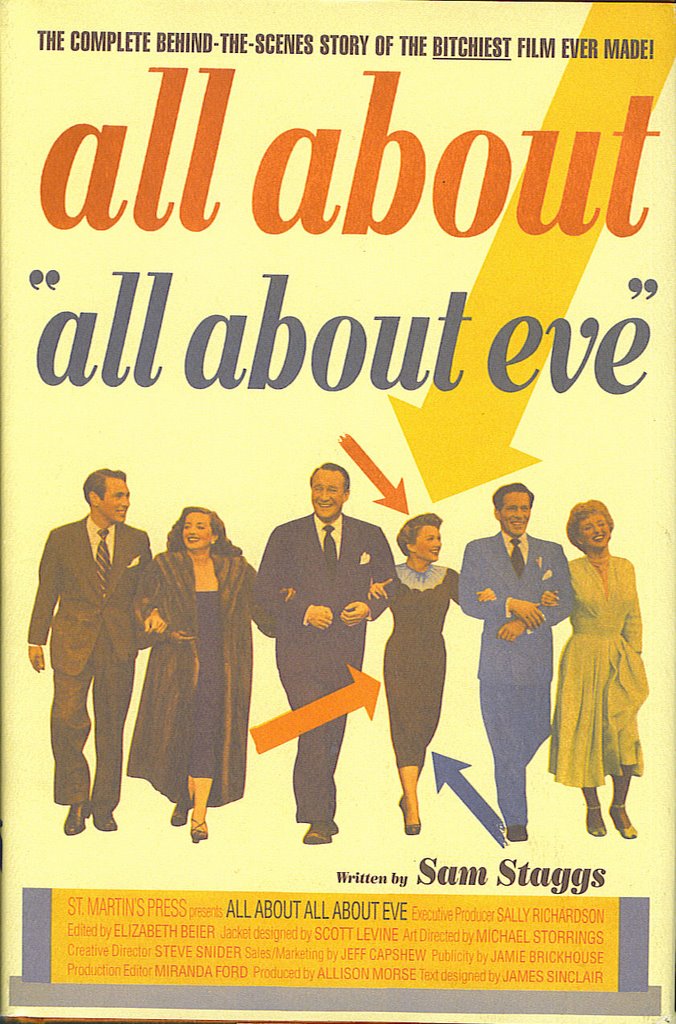
All About "All About Eve" by Sam Staggs.
388 pages, 2000, St. Martin's Press.
I bought this book for Krys because she loves the movie, and when it came around on my alphabetical list, I decided to read it too, because I also enjoy the movie and dig books about individual movies. This is a fun book, too, although it's strangely not as compelling as it could be.

The book is basically written in chronological order, with the publication of the short story on which the movie is based, the machinations to get the rights and begin production, the casting of it, including the fact that Claudette Colbert was going to play Margo Channing until she ruptured a disk in her back just before filming was going to begin. We get a great deal of the behind-the-scenes fun that occurs on any movie set. Bette Davis didn't like Celeste Holm. Both Bette and Gary Merrill cheated on their respective spouses to carry on an affair with each other. Zsa Zsa Gabor, married at that time to George Sanders wanted the part of Phoebe in the movie. Bette Davis lost her voice the day filming began and had to speak the way she did in the movie because of it. There were accusations that she was parodying Tallulah Bankhead with her voice, and bile flew. All the great fun that goes into making a movie is covered. Then Staggs goes on to the release of the film, the Academy Awards ceremony, and Eve's impact on moviemaking and how it still resonates. Finally, he goes into the making of Applause, the 1970 musical based on the original story that saved Lauren Bacall's career, much as Eve saved Bette Davis's.

It's a fun book, and certainly Staggs is a good writer for it. I have no idea if Staggs is gay or not (and I don't care), but he knows a great deal about the gay subculture that has sprung up around the movie and Bette Davis's performance in it. This forms a good part of the book, and it's a fascinating section of it. Staggs also knows a great deal about the moviemaking process, and that's a plus. We get a lot of insight into the nuts and bolts of how Joseph Mankiewicz (whose son, by the way, is a screenwriter on the new Superman movie) managed to get the movie made and get certain things past the censors (which is always a fun part of old movies - the subtext and innuendo), as well as juggling his talented and volatile cast. As with all books about movies, we get stories of the costuming and the set design, which isn't as fascinating but still vital, and we get to hear the gossip about various cast members. One of the biggest problems with the book is that not a lot of the people connected to the movie were still alive by the mid-1990s, when Staggs began the book, and Celeste Holm wanted nothing to do with it. However, Staggs does enough research into other sources that we get enough background into the people involved.

Staggs also ends his book with a long interview with the original Eve, the person on whom Mary Orr based her short story, "The Wisdom of Eve," which was published in Cosmopolitan in 1946. She lived in Venice and was upset that she never got to tell her side of the story. Staggs portrays her as a slightly pathetic person, someone who has been nursing a grievance for fifty years without simply letting it go. She tells of her relationship with Elisabeth Bergner, the star she was supposed to have attempted to supplant, and how Orr told a very skewed side of the story. Staggs, it appears, has a great deal of sympathy for her, but he also points out that she is upset by a fictional story and has lived her entire life with this strange desire to "set the record straight." For a fun book, it's a strangely maudlin way to finish, but it works.

The book has its flaws. Staggs spends far too much time with Applause, the musical, and how it came to be. Given that Staggs himself writes toward the end, "All not-so-great musicals sound rather alike, and this one has plenty of clichéd tunes and lyrics." The long section on Applause doesn't really add much to the legend of All About Eve, and the book would have been stronger if it was trimmed and perhaps Staggs expanded the sections about the impact of Eve and even the behind-the-scenes stuff more. Staggs' first book was MMII: The Return of Marilyn Monroe, and he spends what seems like an inordinate amount of time on Marilyn, especially for someone who has very little screen time. Staggs also has a weird tendency to drop paragraphs into the text describing the fates of some of the characters. We're reading along, and suddenly Staggs adds not quite a non sequitur about what happens to a certain person he's been writing about. They are certainly relevant, but the interrupt the flow. On page 64, he's writing about Gertrude Lawrence, who was a option for Margo. Staggs writes that she decided to star in The King and I, and finishes with this: "Gertrude Lawrence played Anna Leonowens in this smash musical until she was hospitalized with hepatitis in the late summer of 1952 and, instead of convalescing as she had planned, she slipped into a coma and died." What? It's not that the information isn't necessary, it's that it's thrown out so casually. He does this throughout the book, culminating with this on page 314, when he is writing about Gwyda DonHowe, who played Karen Richards in Applause: "Gwyda DonHowe and her husband, producer Norman Kean, spent their lives in the theatre, from the time they met while working in summer stock in 1957 until a January day in 1988 when he murdered her as she lay sleeping and then jumped to his death from the roof of their apartment building." This tragedy is simply mentioned and then Staggs moves on. It's such a strange thing to find in the book, and either Staggs should have done a bit more with this (although I can't see how, since it's such a minor part of the book) or excised it altogether (which would have been better). It's very strange.

All in all, this is a fun book. If you like books about movies, or if you simply love All About Eve, which is a classic, I recommend it. It zips along, it gives you insight, it's sufficiently catty without being evil, and it's an interesting look into how movies affect our society. It's certainly not a deep sociological book, but it is a page-turner. And we can all use more knowledge about Bette Davis, can't we?

Labels: , ,

25.5.06

The movie Stealth is not good

Really, it's not. Avoid it at all costs. Of course, in a movie about Navy fighter pilots, the director thought, "Is there any way I can get Jessica Biel into a bikini?" The answer is "Why, yes, we can."

Labels: , , ,

30.3.06

Underappreciated movies

Gordon's mad love for Zero Effect got me thinking about movies that don't get the love. I'm talking about movies that either didn't do well at the box office, didn't get Golden Globes or Academy Awards, and even seem to be forgotten after their initial release. I like a lot of movies that I think are deserving of wider recognition and should have won some awards of at least get mentioned on "best-of" lists. I often wonder why they don't. So here, in no particular order, are underappreciated movies that you should check out. Because I said so!

1. Fight Club (1999). Okay, this may be cheating a little, as this movie was plenty controversial when it came out and got a lot of press. However, it didn't win any awards, even though it should have, and it doesn't seem to come up much these days. I love this movie. The three leads - Brad Pitt, Edward Norton, and Helena Bonham Carter - have never been better, and the story - even if you know the twist - is powerful and gripping and never compromises. I love movies that allow the story to resolve itself logically, and Fight Club never backs off even at the end. The reason for its greatness, I think, is because it doesn't give us easy answers, and it forces us to consider things we'd rather not. That's why it didn't win any awards, either. But it should still get the love!

2. Zero Effect (1998). Since this movie prompted this post, I should mention it. This movie had franchise written all over it, but it was far too smart for the mouth-breathing troglodytes who go see Sin City with their kids in strollers. Bill Pullman as Daryl Zero, the world's most private private investigator, and Ben Stiller as his Watson, Steve Arlo, are both brilliant in their roles. I have mentioned before that Stiller is a fine actor who is wasting his talent, but here he gets a perfect character and a great script to work with, and he makes it shine. Pullman, another underrated actor, is fantastic as Zero, who never wants to leave his apartment and relies on Arlo to track down facts while he interprets them. Ryan O'Neal is perfectly smarmy as the businessman who hires Zero but has plenty of secrets, and a good chunk of the movie is filmed in Portland, so that's an added bonus. Apparently the television show Monk was loosely based on this movie. And that's a freakin' hit. There's no justice.

3. Fearless (1993). Fearless is Peter Weir's last great movie, although he's done some decent stuff since then. Watching this movie is an astonishing experience, from the beautifully recreated airplane crash at the beginning, to Jeff Bridges and Rosie Perez's drive in the Volvo, to Bridges popping strawberries even though he's allergic to them. Bridges survives the plane crash and becomes, well, fearless. He is disconnected from his wife, played wonderfully by Isabella Rossolini, and finds that he is drawn to Perez, another survivor, but one who lost her baby boy in the crash and is wracked with guilt, something her husband, played by John Turturro, can't understand. Bridges makes it his mission in life to save Perez from her guilt, and as he grows further away from his wife, Rossolini gives a stronger and stronger performance. It's a brilliant movie that won nothing (Perez was nominated for Best Supporting Actress) and rarely gets its due. You can't go wrong if you want to see a bracing portrait of people caught in a situation that nobody has much experience with.

4. Dark City (1998). Alex Proyas made The Crow, another great movie (but not on this list, because I think it's more appreciated than this is), then he made this, then he made ... I, Robot. Oh well - two out of three isn't bad. This is an amazing science-fiction film, with Rufus Sewell (whatever happened to him?) as John Murdoch, who wakes up one night with amnesia and a dead hooker in his hotel room. He quickly learns that he's being experimented on by aliens who want to discover more about the human soul, and things get messier from there. This features great performances all around, from Sewell to Jennifer Connelly as his wife, William Hurt as the police inspector who is investigating the case but also wants to find out why a colleague of his has gone insane, and Kiefer Sutherland doing his best Peter Lorre impersonation. It's a moody, noir-ish kind of movie, and it has a creepy kid with a knife. You really can't go wrong with a creepy kid with a knife! Appreciated by the nerdy sci-fi set, maybe, but sadly not by the rest of the world, even though it examines topics such as what love is and what makes us human. And things blow up!

5. Election (1999). When I hear people talk about Alexander Payne, they talk about Citizen Ruth, his savage satire of both sides of the abortion debate, or About Schmidt, in which Jack Nicholson and Kathy Bates get busy in a hot tub. Eeewwww! Both are good movies, but neither can hold a candle to this, a nasty satire of politics set in high school. Matthew Broderick is a schlub who matches wits with Reese Witherspoon, whose Oscar this year may have been for this role (I think the Academy likes to do that a lot). Witherspoon is truly awesome in the role of Tracy Flick, mainly because we can all remember a student like her from our high school days. Chris Klein (!) is very good (!!) as the dumb jock (oh, no wonder) who opposes her in the race for student body president. He's the only decent one around, it appears, as Witherspoon and Broderick up the ante of evil at every turn. This got nominated for a Best Screenplay Oscar, which is where you can usually find the best movies of the year, but when About Schmidt came out, everyone seemed to forget this. Which is a shame.

6. Lone Star (1996). John Sayles is famous for a lot of things (I once saw one of his plays). Among other things, he wrote the screenplay for Pirahna so he could finance his own movies, and he's written and directed most of his movies all by himself since then. He's hard to pin down - he made The Brother from Another Planet, Matewan, Eight Men Out, The Secret of Roan Inish (another very good movie), Men With Guns (which is mostly in Spanish), and Limbo, among others. Lone Star might be his best - it's a beautiful story about a border town in Texas, and as with many of Sayles' movies, the many characters and their stories overlap with each other. Immigration, racism, progress, assimilation, family ties, violence - all are tackled, and examined without giving short shrift to any and without saying any of them are easy to deal with. The main story deals with Chris Cooper as the town's sheriff investigating the 40-year-old murder of Kris Kristofferson, the town's sheriff back in the bad old days. Cooper's father, played by Matthew McConaughey before he felt the need to take his shirt off in every movie, may have killed him, but the townspeople loved Buddy Deeds (McConaughey), so they don't want to talk. It's a marvelous movie with a wonderful love story (Cooper and Elizabeth Peña, whose mother disapproves of Cooper because he's white), and it always forces you to look at the characters in new ways. It also got an Oscar nomination, also for Best Screenplay. See what I mean about the best movies showing up in that category?

7. The Princess and the Warrior (2000). I have mentioned this movie before, but it's worth mentioning again. This is Tom Tykwer's follow-up to Run Lola Run, and while not as brash or frenetic as that movie, this one (also starring Franka Potente) is much more interesting because of what the characters go through. Potente falls for a bad man, but as we get to know the two, we wonder exactly what is "bad" and "good." It's an interesting movie because there's a palpable sexual tension between the two leads, but Tykwer is much more interested in looking at spiritual love rather than physical love. This slows the movie down a bit, but viewers who want to experience a real relationship should remain patient, because it all comes together satisfyingly.

8. Once Were Warriors (1994). If you're looking for a light-hearted romp, avoid this movie like the plague. This is one of the more unsettling movies you can watch, but that doesn't detract from its utter brilliance. It's the story of a Maori family with, to put it mildly, issues. Rena Owen, who plays the mother, is trying to keep her kids safe and away from all the problems kids face, as well as dealing with the racism that Maoris face in New Zealand. Temuera Morrison, who plays her husband, is a brutal drunk who, when he's sober, is devoted to his wife and kids. Unfortunately, he's rarely sober. This is one of the most powerful movies you will ever see, and it's mostly because of the performances of Owen and Morrison, although all the actors in the family are excellent. The director, Lee Tamahori, came to America and has made thrillers or action movies (Mulholland Falls, The Edge, Along Came A Spider, Die Another Day, xXx: State of the Union), but I doubt he'll ever approach making something as good as this again. He was arrested in January for seeking sex with an undercover police officer while dressed in drag, so he might not be making too many movies in the future. Whatever troubles him, there's no denying that this is a brilliant film.

9. Unbreakable (2000). Shyamalan may be known for The Sixth Sense, but this, his follow-up, is better. Its "twist" doesn't have the same impact, but it doesn't need the same impact, because it's not really about that. This is much more about Bruce Willis becoming a hero and what makes a man do heroic things and how he can overcome adversity. It's also about a man trying to recover his family, because they don't see him as a hero anymore. It's a complex picture, and one of the reasons why I think it doesn't get recognized like it should is because Shyamalan tells the story through the lens of comic books - Samuel L. Jackson's character collects them and discusses their myth-making ability, something "regular" people aren't ready to deal with yet (I hope the continual success of movies based on comic books will change that). This is a fascinating movie about good and evil, and why people commit horrible acts, and it remains Shyamalan's best film (okay, I haven't seen his pre-Sixth Sense stuff, but I can't imagine it's better).

10. Before the Rain (1994). For some unknown reason, this movie has yet to come out on DVD, which is a shame. It's a haunting movie about the problems in Macedonia during the 1990s, and even though that might date it, it's also a movie about war and how it destroys people, but not necessarily in the way you think, and also about how we never learn anything even though we think we do. It's told as three different stories, two in Macedonia, and one in London (with a Macedonian photographer). Milcho Manchevski, the director, plays time tricks with us, so that we are never sure when something is happening, but in the end, it becomes clearer and we understand why he did it the way he did. This movie stars the brilliant Katrin Cartlidge, who died a few years ago much too soon. Some cable channel should do a Cartlidge retrospective - this movie, Naked, Breaking the Waves, Career Girls, Topsy-Turvy, From Hell - she didn't make fun movies, but she sure made excellent ones!

11. A Pure Formality (1994). Krys and I rented this a while back (like, in '96 or '97) and when it was over, I turned to Krys and said, "I can't believe how much I loved that movie." This was astonishing, because usually, when I see a movie for the first time on the television, it doesn't blow me away. But this movie mesmerized me. Since then, two of my friends have seen it, and they liked it but weren't enthralled by it, so your taste may vary. It stars Gérard Depardieu and Roman Polanski (yes, that Roman Polanski) and very few other people. Those two dominate the screen, and it's a good thing, because almost the entire movie takes place in a police station, in an interview room. Depardieu is a writer who has become reclusive, and one night he's hauled into the police station where Polanski interviews him about a corpse they found. Depardieu has no idea what he's talking about, and the conversation between the two men slowly reveals the mystery. This is one of those "twist" movies, yes, but it's brilliantly done and the twist is fascinating and doesn't ruin the movie when you see it a second time (which is what a good "twist" does - makes the movie even more enjoyable). A very underappreciated gem.

12. Heathers (1989). I don't know - is Heathers underappreciated? If it is, it shouldn't be. Teen angst has never been skewered as sublimely as Michael Lehmann (who went on to direct Hudson Hawk and 40 Days and 40 Nights, among others) and Daniel Waters did in this movie. Everyone is perfectly cast, too - Christian Slater can use that faux-Nicholson thing he does to good effect, Winona Ryder is brilliant, and I'm not even sure if Shannon Doherty is acting or just being herself. This movie ripped popularity cliques, teen suicide, teenage rebellion, jocks, hippies - everyone in the high school world, really. Let's all shout: "I love my dead gay son!" Brilliant. Again, I'm not sure if it's underappreciated, but it should be on a short list of great movies of the 1980s.

13. The Fisher King (1991). Terry Gilliam rightly gets credit for Time Bandits, Brazil, and Fear and Loathing in Las Vegas, but for my money, The Fisher King is the best of the lot. This movie moves me in so many ways it's almost painful to watch it. We get Jeff Bridges (hasn't he won an Oscar yet?) and Mercedes Ruehl (who did win an Oscar for this movie) and Robin Williams (who was nominated) and Amanda Plummer, all of whom give career performances. The two love stories (between Bridges and Ruehl, and between Williams and Plummer) are both much better and more real than almost anything you have ever seen on screen, and both Williams and Bridges have to make spiritual journeys to become full-fledged human beings, and they both must overcome horrible obstacles to do so. It's amazing that Gilliam managed to pack so much into this movie and does it so well. It's funny, it's sad, it's adventurous, it's beautiful, it's scary, and it's powerful. Man, Gilliam got it right with this!

14. Grand Canyon (1991). Lawrence Kasdan brought us The Big Chill, but I've never seen that, so I can't speak to that. I like Kasdan a lot, and this movie is fantastic, with a huge cast all intersecting somewhat randomly in Los Angeles. It's a story about race that is more subtle than Crash, it's a love story between two mature adults (Danny Glover and Alfre Woodard), it's a story about empty nest syndrome (Mary McDonnell is upset because her husband, Kevin Kline, is drifting away from her and her son is growing up), it's a story about violence in the movies and why people like it so much when real violence is so horrific (Steve Martin is a producer of violent movies who gets shot and has an epiphany). This is a powerful, uplifting movie about people and how we can all get along, if we only try a little. It was nominated for an Oscar for - wait for it! - Best Screenplay. Imagine that.

15. Bowfinger (1999). Movies making fun of Hollywood better be good, because it's so easy to make fun of Hollywood that we can do it! Luckily, Frank Oz gives us Bobby Bowfinger, wonderfully played by Steve Martin, a hack director with no money who comes up with a plan to film action star Kit Ramsey (Eddie Murphy) secretly and then get his approval later. For the closeups, he stumbles across Kit's brother (also played by Murphy), a bumbling fool with bad vision. The movie they make, "Chubby Rain," is funny enough, but Kit Ramsey is a member of a strange church that couldn't possibly remind anyone of Scientology, and Terence Stamp plays his mentor brilliantly. Heather Graham is the "dumb blonde" who turns out to be not quite as dumb as everyone thinks. This is a wild movie that is fluff, sure, but very well-made fluff. I have mentioned before that Murphy deserved an Oscar nomination for his stunning dual role, but because it's a goofy comedy, the Academy ignored it.

Those are just 15 examples off the top of my head. I'm sure there are more (The Spanish Prisoner! The Rapture!), but I think I'll rein it in. If you're looking for movies that are under the radar, aren't huge blockbusters that are, let's face it, crap, and were criminally overlooked by the Academy in favor of junk like Forrest Gump, check these out. Anyone got any others?

Labels: