Delenda Est Carthago

Why not delve into a twisted mind? Thoughts on the world, history, politics, entertainment, comics, and why all shall call me master!

Name:
Location: Mesa, Arizona, United States

I plan on being the supreme dictator of the country, if not the world. Therefore, you might want to stay on my good side. Just a hint: ABBA rules!

31.7.08

Top Ten Day: My favorite empires

As a history major, I'm a big proponent of the "great man" theory of history - important people having a big impact on history. I mean, let's face it - peasants are pretty much the same throughout history, so although studying them can tell us a lot about how life was like in 13th-century Italy or 20th-century Russia, it can't tell us what the hell was going on, because the peasants were just doing their thing, trying to survive. My kind of history has fallen out of favor as historians focus on the common man more, but to me, it's kind of like the Paris Hilton theory of history - she's famous pretty much because she's alive, not because of any accomplishments. The same holds true for peasants - they are of historical interest simply because they lived, and not because they actually did anything.

Empires are big in "great man" theory of history. Social historians don't care as much about empires, because they contend that it doesn't really matter who's in charge - things will go on as before, and the peasants will suffer. That's kind of my point, but that's not where I'm going with this. I just want to celebrate my favorite empires in history - "favorite" meaning the ones I'm interested in, not necessarily the ones that did the most for human progress. Of course, most rulers of empires aren't interested in human progress. What's an empire? Like irony, I'll know it when I see it. Some call the United States an empire. Sorry, but it doesn't count. But that's just me.

So let's check out some keen empires!

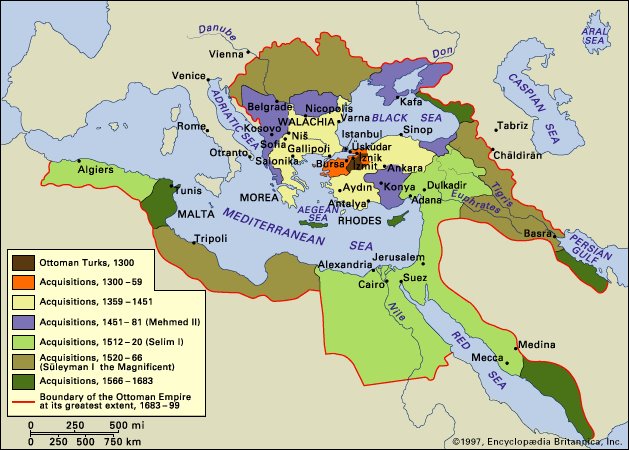
1. The Ottoman Empire, circa 1300-1922. The Ottomans don't get a lot of respect these days, because they were Turks, and everyone knows how horrible the Turks are, right? Ottoman Turkey, however, ruled much of the Middle East for 500 years or so, and the Ottomans contributed quite a bit in terms of military organization and governance. They had some beautiful art, too - a few years ago we went to the Portland Art Museum and saw an exhibit of Ottoman art, which of course drew the ire of the Armenian community in town. The Ottomans brought stability to the Balkans and the Levant, and one of their sultans, Suleiman the Magnificent, might have been the greatest emperor of all time. They almost overran Eastern Europe more than once, which would have completely changed the way history played out and remains a great "what-if" of the world. Yes, the empire became corrupt and frail and was often held together by the European Powers in the nineteenth century because they had their own agendas, but we shouldn't ignore the greatness that was the Ottoman Empire.

The map is from here.

2. The Byzantine Empire, circa 337-1453. This is the Eastern Roman Empire, if you want to be technical, because when Diocletian revamped Rome in the late third century, he split what had become somewhat unwieldy as a single political entity. Then Constantine built Constantinople at what is probably the best place to build a city in the history of mankind (New York might be second-best), and after the West fell, the East became the only Roman Empire, and turned more and more to Greece for their culture and language, hence "Byzantine" after the original Greek settlement on the shores of the Bosporus. The Byzantines are fascinating to me, because their city became the embodiment of empire: as long as Constantinople stood, the empire existed, even at the end, when that's all that was left. I find the emperors wonderful to read about: Justinian and his prostitute-turned-empress wife, Theodora; Heraclius, who finally defeated the Persians only to see his life's work destroyed by a new enemy, the Arabs; Irene, who ruled in 800 when Charlemagne was crowned in the West and may have spurred that decision, because everyone knew a woman couldn't rule an empire; Constantine VII Porphyrogenitus, who wrote a political treatise that gives us lots of information about the tenth century; Basil II, who has one of the best nicknames in history - "Bulgar-Slayer"; and Alexius, John, and Manuel Comnenus, who fought off the Crusaders and helped bring Byzantium its final glory days. Their relations with the West fascinate me, too, as does the Fourth Crusade, when the knights of Europe dared sack the city, earning the enmity of most right-thinking Christians. The final conflict against the Ottomans is interesting, too, as the Byzantines tried to mend fences with Rome against the wishes of their own populace. In a thousand-year history, there's very little that's boring about the Byzantines.

I found the map here, which shows the boundaries of the empire at different times in its history.

3. The Carolingian Empire, 800-843. Yes, it's a short-lived empire, and I suppose I could stretch it out, but the empire was established in 800 and was pretty much destroyed by the Treaty of Verdun in 843. I've written quite a bit about Charlemagne and his empire, so I'll just point out how neat the Carolingian Renaissance is and what a shockingly dynamic ruler Charlemagne really was.

Here is where I found the map.

4. The Roman Empire, 27 B. C.-A. D. 476. The granddaddy of them all! Okay, not really, but the oldest on this list. Rome set the stage for Europe, and as I dig European history, it's not surprising I like this empire so much. Rome is endlessly fascinating, from the early Julio-Claudians and the dominance of the Mediterranean (not to mention their involvement in that Jesus fiasco) to the second-century emperors like Trajan, Hadrian, and Marcus Aurelius to the third-century disasters to the renaissance under Diocletian and Constantine the Great. It's fun to read about the crazy emperors, but part of the interest in Rome is reading about how the fringe cultures and warriors reacted to Rome, from Zenobia in Palmyra to Boudicca in England to the later invasions of Goths and Vandals and whatnot. You could start studying Rome today and do so for the rest of your life and never run out of things to discover. It's quite keen.


5. The Umayyad/Abbasid Empires, 632-750; 758-1258. The early years of Islam are marked by astonishing expansion into northern Africa and east into Persia. This took place under the Umayyads, who were overthrown by the Abbasids in 750. I put the two together because the change in the caliphate was fairly smooth (accompanied by civil war and mass slaughter, to be sure, but once the Abbasids became ascendant, they simply took over). The Umayyads moved to Spain and set up a separate caliphate there, which led to a great flowering of culture on the peninsula. This time is Islam is fascinating, as the Muslims weren't sure what to do with all the possessions they suddenly found themselves with, and toward the end of the period, those tacky Crusaders showed up and upset the china in the Middle East, which unified a somewhat fractured religion against them. The greatest Abbasid caliph was Harun al-Rashid, the contemporary of Charlemagne and the template for the Arabian Nights saga. In 1258 the Mongols obliterated Baghdad and ended the Arab dominance of Islam, setting the stage for the Ottomans to take over the caliphate. It's very interesting to consider that despite Arabic being the official language of Islam and the thing that unites practitioners, there are deep nationalistic rivalries inside the religion, stretching back centuries. Studying Islam from this period helps illuminate what's going on now.

I stole the map from this site.

6. The Angevin Empire, 1154-1216. This ephemeral empire was formed mainly because Henry II of England married well. In 1152, Henry, the duke of Anjou, married Eleanor, duchess of Aquitaine. Eleanor had, two months earlier, divorced Louis VII of France because he was too effete for a man-lovin' woman like Eleanor (okay, who knows why they divorced - my reason is fun!). In 1154, to end England's civil war between King Stephen and Matilda, the daughter of King Henry I, Stephen agreed to name Henry (Matilda's son) as heir. When Stephen died, Henry became king of England. As he held the title of dozens of counties and duchies and whatnot in France and, through Eleanor, more vast land, he became the most powerful ruler in Europe. Hey, that was handy. Henry was the first Platagenet ruler, and with his wife, he had quite the blast, if the history books are to be believed. Of course, he had his best friend killed, but what are you going to do? He also pissed off Eleanor more than once, to the point where she helped her sons rebel against their father, and when Peter O'Toole - I mean, Henry - finally died, Richard and then John ruled after him. Richard, of course, is famous for going on crusade and making nice with Robin Hood in that Disney movie, while John is famous for being a lousy king and losing most of the "empire" that his father had created. It was never an "empire" in the sense of being one administrative state, as each of Henry's possessions had their own culture and governments, but it fun while it lasted!

From here is where I got the map.

7. The Holy Roman/Austrian/Austro-Hungarian Empire, 962-1918. The weirdest empire on this list, the Holy Roman Empire was technically founded by Otto the Great in 962, although ol' Otto tried to link his empire to Charlemagne's as a lot of people did back then. The empire was kept alive through several weak rulers, with only a few rising up to make any impression (Frederick Barbarossa, Frederick II) until the Habsburgs took over in the middle of the 15th century. Under Charles V (1519-1555) the empire reached the height of its power, but from then it declined. After Napoleon put it out of its misery in 1806, it transformed into a Habsburg-run Austrian empire, which became a joint monarchy with Hungary in 1867. It's an interesting empire to study, because it was such a lousy one. The emperor was rarely invested with any power, and unless he had a strong personality, he was helpless against the princes who elected him. Later, after Austria-Hungary became the center of the the empire, it became a baroque monstrosity, the most conservative state in turbulent times. Of course, it was the assassination of the heir to the throne of the empire that sparked the First World War. I have read more than one book that suggests the dismemberment of Austria-Hungary was the worst thing that could have happened for the Balkan nationalities. I don't know if I agree with that theory, but it's certainly something to chew on!


I found the second map here.

8. The German Empire, 1871-1918. I've always been keen on the German Empire, or "second Reich," as a certain Austrian dictator liked to call it. I read a biography of Otto von Bismarck years ago, and it was one of the better history books I've ever read. Plus, Napoleon III's wild ambitions and ruination in 1870-71 (see below) have also fascinated me (as has the Commune, but that's a whole different thing). When I was growing up, I used to read hardcover comics from England that had all kinds of neat stories in them (I lived in Germany, remember). One was about the Commune and how the French tried to get out of Paris during the siege. I guess it hooked me. Bismarck is an intriguing politician, and his relationship with both Wilhelm I and II is very interesting. Germany's escalation of the arms race in the late nineteenth and early twentieth centuries is one of the great tragedies of modern times. It wasn't all Germany's fault, of course, but Wilhelm II was such an odd popinjay that it makes World War I look inevitable. It's a much more interesting state than it gets credit for.

I need to point out that the map came from here.

9. The Second French Empire, 1852-1870. Speaking of the Germans, the emperor that the Germans defeated in the Franco-Prussian War, Napoleon III, ran this empire. He created it and then ran it into the ground. Napoleon, who was the first emperor's nephew, became the president after the 1848 revolution, and then decided to declare himself emperor. Under Napoleon III, France aggressively pursued more colonies in Africa, and Napoleon also tried to establish a client state in Mexico. This, of course, led to the celebration of Cinco de Mayo. Napoleon got in over his head when he declared war on Prussia, leading to utter defeat and his abdication. Napoleon, interestingly enough, was the first president and last monarch of France. The Second Empire is more interesting than the First, because the latter Napoleon was so much more of a schmuck than the original. The fact that he ruled France for 20 years is rather odd.

10. The Japanese Empire. Japan has always been an empire, but I'm keen on the Meiji Restoration era (from 1868) until the war. Japan adopted Western ways, expanded into the Pacific, and beat the snot out of everyone who got in their way. The Japanese did horrible things, especially in China, but the fact that they adapted so quickly to the modern world is very interesting. They wiped out the Russians in 1904, and in the Thirties took over the Pacific. What's most interesting is the way the West attempted to get around their natural racism to explain the rise of Japan. The Japanese war effort is also fascinating, because they could have easily won "their" war without involving the Americans. I like older Japanese history, too, but not as much as this period.

So those are my favorite empires. Empires are awfully swell. Does anyone out there have any favorite empires?

Labels: , ,

19.6.08

Top Ten Day: My favorite vacations

It's been a busy week, because we're getting ready to go to Pennsylvania for a week. Norah's third birthday is on Sunday, and a few months ago we decided to spend it with the families. My mom has been planning a huge party for a while, so that should be fun. In honor of this pseudo-vacation, here are my ten favorite vacations. Some might not count, but I don't care!

1. Australia, February-June 1992. Okay, technically I was studying abroad, but come on. I went Down Under to PARTY! I scheduled my classes so that I had Mondays and Fridays off, and I had the worst GPA in that semester in my entire college career by far. It's not that I didn't like my classes (I took one on postmodern literature, which was awesome, one on novels that had been turned into films, which was also very good, and one on the Reformation, which was really difficult), but that's not why I was there. I had a wonderful time in Australia, and I consider it a vacation. I met fantastic people (and still keep in touch with one of them), spent a lot of time wandering around Melbourne, and went on mini-vacations to Tasmania, Adelaide, Sydney, Brisbane, and (when I was heading home) New Zealand. My parents were celebrating their 25th wedding anniversary in 1992, so they flew out for three weeks, and during my "Spring Break" (which was really Autumn Break, as the seasons are reversed down there), we went all over Victoria, including Ballarat and a beautiful drive along the Great Ocean Road. I don't think it really counts as a vacation, but I don't care. It was a great time and one of the best years of my life (I met Krys later on that same year, in August).

2. Egypt, November 2006. This was the first vacation Krys and I got to take since the birth of the children (or "vacation-killers," as they should be known!), and it immediately vaulted to the top of my list of best "actual" vacations I've taken. Krys planned the whole thing, because that's her thing, and we had a wonderful time despite the fact that for about two days I had some bad feelings in my stomach from eating or drinking something nasty. We saw a ton of stuff in two weeks, met some nice people, and slept really well. Yes, we missed the children, but it was also good to get away from them. If you're a long-time reader of this here blog, you recall I wrote about our Egyptian adventure in great, great detail. If you're interested, check those links out!

3. France, July 1985. My parents took me to Paris in 1985 when they visited friends of theirs from our days in Germany. It was a fantastic vacation. We stayed at their home, which was west of the city and not too far away, and they knew French, so we were able to deal with the snooty French a bit more easily (yes, the French are a bit snooty - that's just the way it is). We saw a ton of cool stuff, ate at excellent restaurants, propositioned a male hooker (our host has a weird sense of humor, and one day while we were driving into town he stopped the car and asked a guy what his rates were), checked out the nearly naked female hookers (yes, the hookers are often almost completely naked - I recall most of them had G-strings and that was about it), and I got beaten at table tennis quite often by their daughter, who is 3-4 years older than I am and quite hot (I was 14, so I blame my failure at ping-pong on the fact that I was busy thinking about how to impress this 17-year-old hottie). Then we went south to the Loire valley (without our hosts), toured there, and then went north to Normandy, seeing Mont-St.-Michel, the Bayeux Tapestry, and the D-Day beaches. It was the last time I've been in Europe, and I really wish we could go back.

4. Venezuela, August 1999. Here's another vacation Krys and I took, our first real international vacation we went on as a couple (Canada doesn't count). I have posted pictures of this in the past, so I'll just write about it briefly. We went on a cruise from Grenada to Venezuela, stopping at several islands and having a wonderful time. It was extremely relaxing, and it was fascinating seeing this part of the world.

5. The United States of America, August-September 1993. When Krys and I graduated from college, we decided to save our money for a few months and the hit the road. We were young, in love, and possessed degrees in English - what better time to hit the road? For over three weeks we drove across the country. We went down the Skyline Boulevard to North Carolina, drove through the Great Smokeys, went up to St. Louis, across Kansas to Denver, north to Wyoming and across the Yellowstone, south through Utah to the Grand Canyon, across to I-5, north to San Francisco, and finally to Portland. There were decided to stay. It was a quite a journey, and it was wonderful to see this great and glorious country, but living in a tent kind of wears on you after a while. We spent two nights out of the tent, and sleeping in a bed rules, man!

6. Barbados, summer 1988. Before my senior year of high school, my parents took the family to Barbados. It's a beautiful island, and we had a great time, even though my mother gets a little weird on vacations. She does not believe in using a vacation to relax, because there's way too much to do! So we relaxed a lot, but we also saw a lot of stuff. Bridgetown, the capital, is a typical Caribbean town, but it has a lot of charm. We went to a sugar plantation, where we all drank rum (yes, we little ones could drink). Barbadian (Barbadosian?) rum is really good. It was a fun trip, even though I had to take a copy of Miracle at Philadelphia along because I had a summer assignment for my AP American History class. Reading that book on the beach was no fun, I'll tell you that much. But the vacation was cool!

7. New Orleans, October 1995. Krys and I went to New Orleans as our "honeymoon," well over a year after we got married. Hey, we had no money when we first got married! We had a nice week in the Crescent City. We stayed in a small bed and breakfast with a beautiful courtyard right north of the French Quarter. We wandered around the Quarter, took a riverboat ride, saw a little bit of downtown, went to the aquarium, and took a tour in the countryside of a few plantations. It's a beautiful city, although I think it's a foolish place to put a city. Plus, the Louisianans are still in denial about the slave-owning past. They go out of their way to say that slaves in the state were treated far better than they were elsewhere in the South. Yes, but they were still slaves! Just deal with it, Louisianans!

8. Walt Disney World, 1980, 1986. Yes, it's two vacations in one! I went to Disney World twice and I can't really decide which one was better, mostly because they've kind of melded in my mind. The first time we stayed at The Polynesian resort, which was pretty frickin' cool, and the second time we stayed at The Disney Inn, which is further away but cheaper. I always liked Disney World, mostly because of all the other stuff beside the actual theme park. I mean, the water park is my favorite. The second time we went, I was a bit older, so I flirted with the female park workers. Plus, Epcot Center had just opened, so it was cool wandering around there. Disney World is a huge place and you could probably spend a good month there, but it's also ridiculously expensive. I probably should thank my parents for taking me there.

9. Italy, Christmastime 1977. When I lived in Germany, we went on a lot of vacations, because my mom loves traveling and every country in Europe is so close together, it's easy! My favorite vacation was one of the times we went to Italy. We took a boat from Naples to Palermo. The fun started on the boat, when my sister started sleepwalking. For some reason, we woke up before she did, perhaps because she was climbing out of her bunk bed saying, and I shit you not, "Guy, where are you?" She then jumped onto the floor, waking up. We still, to this day, have no idea who Guy is or why my sister wanted to know where he was. Anyway, Palermo is a beautiful city, and we saw many steps and columns. We drove around Sicily for a while, then saw Mount Etna erupt. That was pretty frickin' awesome, let me tell you. We were on another mountain, so we were perfectly safe, and it was at night, so we could really see the lava well, even though it was far away. It was quite the interesting journey.

10. Pontresina, February 1979. Our last vacation in Europe was a ski trip to this Swiss resort. It's near St. Moritz, which is more famous, but my parents really liked it here. My mom said if they had known how nice it was we would have gone every year (German schools often have a break in February, usually so people can go skiing) instead of going to a different Swiss or Austrian resort. I remember amazing skiing, and I'm pretty sure we crossed the border into Austria at one point (or maybe Italy). A lot of Alpine ski resorts are above the tree line, so they don't have trails, just wide open snow fields that are wonderful to ski. Another great thing is that they're so long you often only go up one time on a cable car, and then spend the day skiing down (while stopping at a restaurant halfway down for lunch). More skiing, less time on a lift = good times!

So those are my favorite vacations. Maybe this one to Pennsylvania will be one, but I doubt it. Spending time where I grew up doesn't really count, even though it will be great to see family and friends. At least I can catch up on my sleep!

Until then, talk amongst yourselves. I'll have access to a computer there, so I might post something, but I may not have time. We'll see!

Labels: ,

10.4.08

Top Ten Day: My favorite crushes

Roger, ripping off an unnamed blogger, published his list of famous people on whom he had crushes, and challenged us to do the same, either by leaving comments or posting about it on our own blogs. As I have a blog and shamelessly rip off others' topics all the time (well, not all the time, but I'm not above it!), I thought I would take him up on his challenge here. These are, of course, not girls from school or anything, because that would be meaningless to you. No, as Roger's is, these are famous people I dug, for whatever reason. Let's get to the list, as we peer deep inside Greg's depraved mind!


1. Daisy Duke (Catherine Bach), 1979-80. I watched The Dukes of Hazzard for most of its time on television, but that first year was dynamite, especially when Daisy showed up. Dang, she was a hottie. My eight-year-old brain couldn't quite process it. I wasn't terribly interested in girls until much later in my life, because I was still a rough-and-tumble boy, but Daisy showed me that when I became interested, there would be something nice to look forward to!


2. Bailey Quarters (Jan Smithers), c. 1980. Loni Anderson was the sexpot on WKRP in Cincinnati, but come on - Bailey was super-sexy. She was smart, sarcastic, and funny. Yes, Jennifer (Loni Anderson) was smarter than most of the people at the station, but her character always felt a bit fake, whereas you could easily imagine knowing someone like Bailey. And whenever she took those glasses off - hubba-hubba! Like Daisy Duke, she was one of those women who made me realize there was a lot more going on with girls than I suspected, even though it would be years before I explored that. I read on this site that Smithers was in a pretty serious car accident last September. That sucks. I haven't read anything about her recovery, except that as of December, she had a lot of broken bones and still couldn't walk. Send good thoughts her way!

(This is a pretty cool picture. Smithers was, oddly enough, on the cover of Newsweek in 1966, when she was 17. What a weird thing.)

3. Sarah Purcell, early 1980s. Ms. Purcell is someone that is probably far-from-crushworthy, but I don't care! I loved watching Real People back in the early Eighties, as it was funny, featured interesting people, and had very funny hosts, including Fred Willard. But Sarah was the hottie on the show. Considering she's only five years younger than my mother, maybe I had some Oedipal issues I was working out back then. Many were the nights when I wished I had Sarah Purcell and Fred Willard as my parents! And Peter Billingsley could be my cool older brother (he's almost exactly a month older than I am), with Byron Allen the non-Caucasian uncle from one of my grandfather's many dalliances! Oh, the joy! (Oh, I'm kidding. My parents are awesome. But I did have a big crush on Sarah Purcell. About that I will not kid!) (And no, I couldn't find a better picture of her. She's just pimpin' fine early Eighties products!)

4. Phoebe Cates, 1982. Any straight male under the age of 30 (at the time) who saw Fast Times at Ridgemont High knows why:


Dang. You know we're all about high-brow entertainment around here! I still liked her in the two Gremlins movies (especially the second one), but this moment is iconic.

5. Jennifer Jason Leigh, 1982-1994. I absolutely adore Jennifer Jason Leigh, and think it's a tragedy of epic proportions that she hasn't won an Academy Award yet (and Big Lips, among others, has). Leigh, of course, burst onto the scene in Fast Times at Ridgemont High, where she played the innocent Stacy to Phoebe Cates' more worldly Linda, and she quickly put together an amazing résumé: Flesh + Blood, The Hitcher, Miami Blues, Backdraft (well, I liked it, and she was damned sexy in it), Rush, Short Cuts, The Hudsucker Proxy, and Mrs. Parker and the Vicious Circle. I like that movie, but that was about the time my crush started to fade. I still love her as an actress, and she's very good in Dolores Claiborne and eXistenZ, but she faded out of view for a while in the new century, and I was depressed that she didn't have a bigger role in Road to Perdition. And, of course, I don't see many movies these days. She seems to be working a bit more recently, so maybe someone will give her a role that will finally win her an Oscar.


6. Keanu Reeves, 1989-1999. I'm not sure why people denigrate Keanu so much. I'm the first to admit that he's not the greatest actor, but he chooses smart roles and never embarrasses himself. I first started getting a man-crush on him when I saw Bill and Ted's Excellent Adventure, which is still a comedic classic. I eventually watched his seminal film role in River's Edge, which is an absolutely brilliant movie. He followed Bill and Ted's with Parenthood, in which he's fantastic, and I Love You to Death, which is an underrated comedy, and after Point Break and Bill and Ted's Bogus Journey (neither of which is all that great, although the sequel is mostly fun), he was astounding in My Own Private Idaho, showing how good he could be. He shows up in movies by great directors (not necessarily great movies, but by great directors), and he even showed he could do action well in Speed (after doing it poorly in Point Break). Of course, he had a small career renaissance in 1999 with The Matrix, and he did a pretty good job in Constantine. Keanu is a far better actor than he gets credit for, and he's one of my two man-crushes on this list.

7. Sherilyn Fenn, 1990-93. Man, Sherilyn Fenn should have been a classic movie star. She's not the best actress, but she's not the worst, either, and she has such classic movie star looks. It's like she was born about 50 years too late - if she had been an actress in the 1940s or '50s, she would have been huge. I never watched Twin Peaks (I know, shocking), but she was a pin-up icon for a while in the early Nineties, and I actually bought the issue of Playboy in which she posed. I still have not seen Two Moon Junction (Krys has, weirdly enough), but I have seen Meridian, which is a truly awful movie. I saw Boxing Helena, but by that time I had moved on in my crushes. She's still working relatively steadily, and she has a MySpace page (if it's really hers), so if you too had a crush on Sherilyn Fenn, go check her out! And really, who could forget her in Just One of the Guys? What a classic that was!


8. Emma Thompson, c. 1991-1994. I still love Emma Thompson as an actress (she was quite good in Stranger Than Fiction, and I have actually watched good swaths of Nanny McPhee because she's in it), but my crush phase lasted only briefly, from the time I first saw her in Dead Again (I later saw Henry V, but not when it was first released, so it doesn't count), which is an extremely underrated murder mystery, until her brilliant turn in In the Name of the Father, one of the few movies that makes me cry. In that same year she made Much Ado About Nothing, in which she is absolutely gorgeous. In the late Nineties she was under the radar a bit, but she seems to be coming back strong recently. My crush will not return, but I'm always happy to see her working.

9. Michelle Yeoh, 1993-2000. I first saw Michelle Yeoh in the Jackie Chan vehicle Supercop, which came out here in 1993 (and stars another actress I had a crush on, Maggie Cheung) and is a real blast. Yeoh is excellent, fighting and flirting (a bit) with Chan and almost stealing the movie. She was the best part of Tomorrow Never Dies, which is a fairly decent addition to the Bond legacy, and of course, she was brilliant in Crouching Tiger, Hidden Dragon, which is an excellent movie. She's worked since then, but I've been missing her movies, as I rarely see movies anymore, so my ardor for her has cooled. I still think she's awesome, though, and probably will be the only reason to see the third Mummy movie.


10. Brad Pitt, 1995-2001. Ah, my second man-crush. I first saw Pitt in Thelma & Louise, but he didn't really do it for me. Luckily, my first time seeing him was NOT Cool World, because that movie is, well, awful. Then, I saw (unfortunately), Interview With the Vampire, but I still didn't have much interest in him (and I still haven't seen A River Runs Through It). If I had seen Legends of the Fall in the theater (instead of a few years later), that might have done it, but my crush really started with Seven. He was excellent in that, and then, a few months later, he was hilariously disturbing in 12 Monkeys. That was it: I had a crush. Of course, it reached its peak in 1999, when Fight Club came out. It's one of my favorite movies, and everyone in it is brilliant. I also would love to have Pitt's wardrobe from the movie, although I'm not cool enough to pull it off. After that, he was very funny in Snatch, the best thing about The Mexican, very good in Spy Game, and hysterical in that episode of Friends. Then, of course, he was in Ocean's Eleven, where once again I would love his wardrobe but couldn't pull it off. Plus, he got to say, "I had never been to Belize" (trust me, it's a funny line). Since then, I have seen fewer movies, he got involved with Big Lips, and his movies haven't been as excellent (although he's quite good in Babel). I've heard his turn as Jesse James is pretty good, and I still like seeing his movies, but I think my crush is over. So sad!

Well, those are my ten favorite crushes. I've had others (I mentioned Maggie Cheung, for instance), but they've either been fleeting or not as intense. One retroactive one I've had is on Daniela Bianchi, because she was a Bond girl before I was born, so I can't really count her. But it gives me an excuse to post a picture of her. Yowza!


What about my vast readership? Any celebrity crushes you care to share with us?

Labels: , , , ,

27.3.08

Top Ten Day: My favorite science fiction books

In the wake of Arthur C. Clarke's death, I thought I'd list my favorite science fiction books. Yes, I started this post last week, but his death is still recent enough to make this relevant. So here they are, in chronological order!

1. Slaughterhouse-5 by Kurt Vonnegut (1969). This is not only one of my favorite science fiction books, but one of my favorite books, period. It's very funny and very tragic, and Vonnegut comes up with pithy phrases that encapsulate so much horror. Vonnegut skips back and forth in time, as his hero, Billy Pilgrim, has become "unstuck" from time and is able to travel to any point in his life. We get the weird period he spends on Tralfamadore with Montana Wildhack, the porn star, and we get the horrific bombing of Dresden, but it never feels disjointed. It's a masterpiece, and I should probably go read some more Vonnegut, shouldn't I?

2. The Forever War by Joe Haldeman (1974). It's been a long time since I read this, but it's still an excellent book, harrowing and tragic and a nice allegory about soldiers fighting wars they don't understand. It's probably not too big a leap to think that Haldeman was thinking a little bit about Vietnam when he wrote this. The main character is fighting a war against an alien species, and despite his tours of duty being relatively short, because of time dilation, he misses decades on Earth and finds that society has changed so much the only thing that keeps him sane is returning to the army. It's an exciting war book, which made my teenaged self happy, but at its core, it's a devastating examination on the effects war has on soldiers. I recently bought it - I really ought to read it again.

3. A Swiftly Tilting Planet by Madeleine L'Engle (1978). A Wrinkle in Time is better-known, but this, written about twenty years later, shows L'Engle's growth as a writer - it's far more mature, subtle, interesting, and powerful. Charles Wallace, the young boy from the first two books of this trilogy (A Wind in the Door is the second book), is now a teenager, and he flies a unicorn through time to avert a nuclear disaster. L'Engle introduces several characters from throughout time, linking everything together very elegantly, and the story becomes one of love through the ages and its power in overcoming evil. It's written for teens, as are most L'Engle books, but it's a book that adults can enjoy as well.

4. The Fountains of Paradise by Arthur C. Clarke (1979). I like a lot of Clarke novels, but this one is spectacular. An engineer conceives of a "space elevator" linking an island in the Pacific (it's called Taprobane in the book, but it's basically Sri Lanka, where Clarke spent most of the latter part of his life) to a satellite in geosynchronous orbit. Vannevar Morgan believes this will allow spaceships to dock without using rockets to get off the ground, which is much more cost-effective. Clarke also tells the story of an ancient king, Kalidasa, whose drive mirrors Morgan's. It's a wonderful book, the kind of science fiction that not only offers a plausible vision of the future but also explores the human condition. Clarke often does this, but rarely with such aplomb. It's magnificent.

5. Job: A Comedy of Justice by Robert Heinlein (1984). This was the first Heinlein book I read, and still remains my favorite. I've never been a big fan of his other stuff, although Time Enough for Love is quite good. Job tells the story of a minister who somehow switches realities, always with his newfound love, Margethe, by his side. He soon learns that it's a build-up to the Rapture, and when that occurs, he has to make a choice between his religion and his love. It's a fairly raunchy book (nothing too hardcore, but quite lewd nonetheless), it's wildly funny and very satirical. At its core, however, it's a nice love story.

6. The Messiah Choice by Jack L. Chalker (1985). This is, I suppose, not quite true "science fiction," in that it deals with demonic possession and a war against, well, Satan, but I consider it science fiction because of the vast telecommunication system that plays such a crucial part of the book, which in 1985 was still in the realm of fantasy. This is an exciting book, one that has a lot of nice Christian touches without being a Christian tract. Satan does indeed attempt to bring about the Apocalypse, but the hero has a more generic kind of faith than a true Christian one. Despite the fact that it's a ripping page-turner, it still manages to explore the problems of technology gone mad and how to stay human in an increasingly mechanized world. (It's also out of print, which kind of sucks.)

7. Dirk Gently's Holistic Detective Agency by Douglas Adams (1987). Dirk is one of my favorite fictional detectives, and this, the first book starring him, is marvelous - a mishmash of genres, with ghosts, aliens, time travelers, and Samuel Taylor Coleridge all playing important roles. It's very funny, in an altogether more mature humor vein than the Hitchhiker books (the first of which would have made this list, except I tried to limit myself to one book per author, and I like this more than the book that made Adams a superstar), and it's also an very interesting mystery. It's convoluted but, unlike the next book with Dirk (The Long Dark Tea-Time of the Soul), makes perfect sense once it's all explained (the follow-up still puzzles me a little). Adams returned to his cash cow after writing two Dirk Gently books, and of course died prematurely, but I do wish he had been able to write a few more.

8. Liege-Killer by Christopher Hinz (1987). Hinz doesn't seem to be a big name in sci-fi, and that's a shame, because his Paratwa trilogy, which begins with this book, is fantastic. This is the best of the three, because the next two got a bit too esoteric. Not that that's necessarily a bad thing, but this book manages to balance strange philosophy with rip-snorting action, and the mystery of the book is compelling as well. The story takes place after Earth's nuclear destruction, when mankind lives on hundreds of satellites orbiting the dead planet. In the frenzy of technology before the end, mankind created the Paratwa, deadly assassins that are two separate bodies governed by one mind. They can function as independent beings or as a single entity, basically a killer with four arms and four eyes, making them very hard to kill. In this first novel, a Paratwa is awakened on the colonies, and two ancient Paratwa-hunters are revived from stasis to find it. Hinz makes trenchant points about genetic engineering and political machinations, as we learn that one of the ruling caste of the Paratwa - an Ash Ock - is living in the colonies and manipulating humankind, but he also makes sure that the book is a thriller. I absolutely love this book.

9. Xenocide by Orson Scott Card (1991). Card is one of my favorite sci-fi authors, despite his rather rightist political leanings. I met him once, in 1986, at the World Trade Center in New York. His Alvin Maker books are my favorite, but I can't think of a single volume that's better than any others, and they stretch the definition of speculative fiction into fantasy fiction anyway. Xenocide is the third book in a quartet that began with Ender's Game, which is probably his best-known novel. Xenocide is a far more mature work, however. It's a book about genocide and how human arrogance leads to destruction and how people need to overcome their basic instincts to co-exist. It's also a fairly interesting mystery, in that Ender must discover how the lifeforms on Lusitania (the planet at the center of the book) live. It's a nice balance, too, between the harder science fiction of Card's earlier work and the wildly esoteric stuff he does later in the final book of the series, Children of the Mind. I may not like Card's politics, but he's a very good writer.

10. Imajica by Clive Barker (1991). Imajica is a massive book, and to attempt to summarize it, even a little, would be pointless. It's the first (and so far, only) Barker book I've read (I own a few others, but haven't read them yet), and it left me breathless. It's a Quest novel, full of magic and sex and violence and ruminations on religion. It's often tough to follow, because Barker packs it with so many characters and worlds, but it's a wonderful experience reading it. If you've never read any Clive Barker, start here.

I see that in recent years I have tended to move away from science fiction a bit. It's not that I don't like it anymore, I just got interested in a lot of other stuff too. It's also hard to separate the wheat from the chaff when it comes to science fiction (like a lot of pure genre fiction). I mean, have you been to the bookstore recently and checked out the sci-fi section? Holy crap, it's huge! How can I tell what's good and what's not?

Anyway, what's on your list of favorite science fiction novels! Embrace your inner geek and let it out!

Labels: , ,

7.3.08

Top Ten Day: My favorite hair metal videos

Ah, the 1980s. A great time to be a suburban American lad. The streets were safe, the girls used lots of hair spray, the television shows were full of virile men toting large guns, and the bands wore more make-up than the school slut and played aggressive, in-your-face metal but could also show their sensitive sides. Yes, it was the age of HAIR METAL! What red-blooded teenaged boy could resist? And lo, Kip Winger spoke unto us, telling us that seventeen might be too young for the girl's father, but she's old enough for him; David Coverdale showed us that the safest way to drive is with a redhead half your age Frenching you while dangling out the window; and Slaughter explained that it was best to be up all night while sleeping all day. The videos, of course, made hair metal and even, somewhat, destroyed it. But for almost a decade (let's say 1983-1991), hair bands ruled the world. And I was along for the ride. Until Nirvana ruined it all!

I could probably list 100 of my favorite hair metal videos, but let's stick to ten, shall we? (I should probably point out that some of these videos aren't of the best sound quality, and the lip-syncing on one is really horrible. But that's what you get from YouTube, unfortunately!)

Cinderella, "Nobody's Fool." This isn't the best Cinderella song, but it might be the best video. Tom Keifer and the guys are in full hair metal mode, the "story" of the video, in which a girl transforms into a modern-day Cinderella, is awesome, and it features the guitar twirl! How can you not love it?


Def Leppard, "Rock of Ages." The chick strapped to a tree. The burning tree. The gloved hand crushing a wine glass. The hooded apparitions speaking what sounds like German. An ass shot of lead guitarist Phil Collen! What an awesome video. What a great song. (I guess technically the guys' hair wasn't really poofy until Hysteria in 1987, but I consider Pyromania a seminal "hair metal" album, even if the hair is only long and not high. That, and the songs on Pyromania are far better than those on Hysteria.)


Great White, "Once Bitten, Twice Shy." This is a very good song (of course, it's a cover of an old Mott the Hoople song), with that great piano part and a pretty cool guitar solo. I like the video, even though it's just a standard "performance" video, because the lead singer, Jack Russell, is so stinkin' ugly, but you know he was getting laid every night, and I liked the girls (of course). I always thought the girl second from the right when they're all singing (whose breasts get their own close-up near the end) was smokin' hot. Come on - I was 18!


Mötley Crüe, "Home Sweet Home." Is this the greatest power ballad ever? It's in the conversation. This might not be my favorite Crüe song (that's probably "Wildside"), but it's close. But this song and video are so classic, with all the elements of a great concert video - notably, girls crawling on the stage and taking their tops off! Man, the Eighties ruled!


Queensryche, "Eyes of a Stranger." I love this song, off an album that might be the best heavy metal album of the Eighties. Geoff Tate, rocking the hair, screams the lyrics, and the video is part of the whole "concept album" thing that Queensryche had going on with Operation: Mindcrime. And you must love guitarist Michael Wilton's awesome hat!


Skid Row, "I Remember You." This is one of those great pseudo-ballads by a hair metal, meaning it's somewhat sensitive but still features kick-ass guitars and a bit of a scream. There's a reason they were called "power ballads," because they were muscular love songs, man! Sebastian Bach, of course, was the pretty boy front man of Skid Row, and although he was probably scoring four or five groupies a day, at least he was good-looking, unlike a lot of these rockers! This video must have been cribbed from a karaoke screen, because it has helpful lyrics!


Van Halen, "Hot for Teacher." Another song that isn't the greatest, but you have to love the video! David Lee driving the bus, the guys in their school days, the ending that shows where they all ended up (Edward van Halen was "relaxing" in Bellevue Mental Ward), and, of course, the hot teachers!


Warrant, "Cherry Pie." I can't defend this song. In fact, I don't even like it that much. But this video is the perfect epitome of the age: slightly feminine guys, skanky hot chicks, big hair (of course!), rockin' guitars, and totally juvenile sex puns. Sing along!


Whitesnake, "Still of the Night." Of course, Whitesnake is famous for their "Here I Go Again" video, with Tawny Kitaen writhing around on a Jaguar, but I like this song more (despite the fact that it rips off Zeppelin), and the video features Tawny as well. So who can complain?


Winger, "Seventeen." Ah, Kip. What a pretty boy. I love this video, even though it's a standard "performance" video, because Kip treats his bass like a prop, only occasionally pretending to play it, and the fact that he studied ballet makes this a really odd video, as he dances around much more gracefully than you might expect. And his poor shirt doesn't survive the video. Too bad!


There are, of course, way too many great videos to mention. Krys and I were just sitting here spitballing, and I had to stop before I listed another 10. But, while I was trolling YouTube, I thought of a bonus, which definitely doesn't count as "hair metal," because Rob Halford didn't have any hair! Fear the magic finger of Rob Halford! Fear it!


All right, that's enough. I'm having way too much fun. What are your favorite hair metal videos? Don't be shy - we know you loved them all!

Labels: , , ,

29.2.08

Top Ten Day: My favorite fictional detectives

Ruminating on the Hardy Boys a while back made my think of my favorite fictional detectives. So here they are, in no particular order! And yes, I originally started this post a few weeks ago, but just didn't have time to finish it. But that's okay - it's my blog, so I make the schedule, consarnit!

1. Jupiter Jones of the Three Investigators. In that same post, I mentioned I like the Three Investigators more than the Hardy Boys. I don't know why - maybe it's because they felt more contemporary than the Hardys (even though I did enjoy the Hardy Boys, don't get me wrong; but the first Three Investigators book came out in 1964, while the first Hardy Boys came out in 1927) and their adventures felt a bit more dangerous. The Hardys seemed to deal with mysteries that were often about smugglers and bank robbers, while the Three Investigators dealt with some real sadists. Jupiter was the brains of the outfit, while Bob Andrews and Pete Crenshaw were often along for the ride and to provide some muscle, such as it was. I liked Jupiter because he was portly, unathletic, and kind of surly - he was likable, but not a typical hero. The mysteries were complex but not too difficult, and the setting - modern Los Angeles - made this series feel like "adult" books while still being appropriate for kids. I still have some of the books at my parents' house, and I should try to get a complete set. They're fun books to read.

2. Sherlock Holmes. I was not into Holmes for many years, even though I had read many of the stories. Then I got the annotated version that came out a few years ago, and I devoured it. Man, I loved reading those stories. When you get a lot of the context to them, they become far more interesting. Conan Doyle wasn't the greatest writer of mysteries, as the annotations show, and Holmes often gets stuff wrong, but the personality Conan Doyle gave him is so neat that we can't help but be fascinated by him. He's a jerk, but a riveting jerk. And the stories, even the ones that don't make much sense, are interesting and often very exciting. I've never been a fan of Holmes pastiches, but I can see why people write them. He's neat.

3. Thomas Magnum. I've mentioned my love of Magnum, P. I. before, and it stems from my mom's love of Tom Selleck back in the day. She used to watch it every week, and I, being a young lad who couldn't go out wilding, would watch with her. These days you can catch reruns of WGN or Sleuth, and I tune in when I can. The great thing about Magnum was that he never seemed like that good an investigator, but when he needed to be, he was. His cases were quirky and strange, he very often took cases for which he knew there would be no payment, yet he didn't care, because he somehow got a job that allowed him to live in a mansion and drive a Ferrari. That always bugged me - did Robin actually pay him, or was the house and the car payment? Robin's rich, so it seems like he would get a good salary on top of the living arrangements, yet Magnum was always poor. Anyway, what made the show work were the relationships between the four leads, but also the unusual ways Magnum would get involved in the episode's plot. It wasn't just someone coming to him with a problem. Also, the show had some great guest stars - Ian McShane, June Lockhart, Ted Danson, Erin Gray, Morgan Fairchild, Ernest Borgnine, Shannen Doherty, Carol Burnett, Sharon Stone (in a stunning dual role!), Cesar Romero, Norman Fell, and Frank Sinatra, just to name a few. Plus, they actually did a crossover with Simon & Simon, which was nifty.

4. Hercule Poirot. I have been an Agatha Christie fan for years, but really only of Hercule Poirot novels (the lone exception is And Then There Were None) - I just can't get into Miss Marple books. My favorite Poirot book is Murder on the Orient Express (I like the movie, too), but I don't think I've ever not enjoyed one. I always loved his characterization - he's a fussy little man, probably gay, who is so off-putting to the suspects in the murders, who always underestimate him. He's also, if possible, ruder to Arthur Hastings than Holmes was to Watson, even though there's also affection between both sets of men. Like Holmes, he can be rather annoying, but in a different way than Holmes. His final case, Curtain, is a brilliant book, fascinating and chilling all at once. And Albert Finney and Peter Ustinov played him excellently in the movies, too.

5. Jennifer Mays and Gabriel Webb of the Maze Agency. The Maze Agency was a comic book published in the late 1980s and early 1990s which was recently revived briefly. Mike W. Barr, a wildly underrated comic writer, created the series, which came out after Moonlighting and therefore might seem like a rip-off: the rich woman owns the agency and the charming rogue shows up and helps out on cases. Mays, however, is an ex-CIA agent, while Webb is a true-crime writer. The reason I like these two is that they are a couple from the beginning of the comic, and Barr does a nice job with the interplay between them, whether it's pillow talk or when they're solving crimes. The crimes are serious, but Barr manages to keep the tone a bit light. This never became a big hit, but they are very good comics.

6. Dirk Gently. Douglas Adams is, naturally, better known for The Hitchhiker's Guide to the Galaxy and its spawn of sequels, but the two books he wrote starring Dirk Gently are better, and I wish he had managed to write a few more before his death. Dirk is a "holistic" detective, meaning he examines every aspect of the case and/or the people involved to reach a conclusion, which means he often goes "fact-finding" in the Bahamas on his clients' pound, because you never know what crucial piece of information will turn up on the beach! The two books starring Dirk, Dirk Gently's Holistic Detective Agency and The Long Dark Tea-Time of the Soul, involve ghosts, time travel, aliens, Samuel Taylor Coleridge, Thor and the Norse gods, an I Ching calculator, and the selling of souls. Both are wildly convoluted yet amazingly fun to decipher, and I, at least, still haven't figured everything out, even though I've read them multiple times. I would recommend them over the Hitchhiker books (even though I really dig those, two), and I'm recommending them now!

7. Remington Steele. I haven't seen a lot of this television show, but it's another one my mother always liked, and I dig the concept. Stephanie Zimbalist isn't getting clients because no one takes a female detective seriously, so she invents one - Remington Steele - and claims he's her boss. So, of course, Pierce Brosnan shows up and convinces everyone he's Remington Steele. Whenever I watched the show, I liked it, because it has nice sexual tension between the two leads and some deeper-than-you-might-think sexual politics, too. Doris Roberts as the secretary is quite funny, far moreso than her annoying mother role on Everybody Loves Raymond. I should get this series on DVD. It would be fun to watch more episodes, as I missed quite many of them.

8. Jessica Jones. Jessica is the star of Alias, Brian Michael Bendis's pulpy Marvel comic that ran from 2001 to 2004. Despite the fact that Bendis loves the character and has inserted her into every significant event in Marvel history (it seems), her appearance in Alias is wonderful. She's an ex-superhero, so she has powers that she hardly ever uses, and she's very smart at solving cases and bad at everything else in her life. She smokes, drinks too much, has too many one-night stands, curses way too much, and makes a mess of things whenever she tries to get close to anyone. But her cases, which often intersect with famous Marvel icons, are fascinating. Read more about the series here.

9. Sam Spade. It may be hard to believe, but I've only seen or read one Sam Spade adventure - The Maltese Falcon. And I haven't even read that, relying instead on the movie version! Yes, I suck. But come on - it's Bogart! I love everything about him - he's kind of a jerk, tough with the bad guys and ladies, ready to hop into bed with the dame, but never falling for her and therefore able to keep his wits about him. He's only slightly less morally bankrupt than everyone else, which is why he wins out in the end - remember, this was 1941, so a villain couldn't win! This is a wonderful movie to watch again and again, and it makes me think I probably ought to watch more Spade movies ... and more Bogart movies.

10. Daryl Zero. I've only seen The Zero Effect once, which is a great defect in my character, I know. This 1998 movie is absolutely brilliant, with Bill Pullman starring as the world's most brilliant and reclusive detective and Ben Stiller (when he was still a decent actor) as his Dr. Watson. Pullman is completely socially inept, so when he falls in love, it's funny but a bit like watching a train wreck. Plus, the mystery is interesting. And it was filmed largely in Portland, which is an added bonus. It's a shame this movie didn't get more love when it came out, because it really is excellent. And Gordon loves it! Who doesn't trust Gordon?

So that's my list. Do you have any favorite fictional detectives?

Labels: , ,

7.2.08

Top Ten Day: My favorite Christian sects

I don't know why I thought of this topic, or if it will be interesting to anyone but me (maybe this guy), but I've always been fascinated by the various divisions in Christianity (being a history major of European history, this is perhaps not shocking), and naturally I have favorites. So here are my ten favorite, in no particular order (except for the first two, which are my absolute favorites!):

1. The Anabaptists. This group, which tried to create some kind of utopia in the German town of Münster in the 1530s, was notable because they believed that infant baptism was invalid and that only adults could receive it. Now, today this might not seem too radical, but back then, despite the Protestant Reformation sweeping Europe, that was crazy talk! In fact, a lot of Protestants persecuted the Anabaptists, because they learned quickly from the Catholics about oppressing people who thought differently than they did. A bunch of Anabaptists took over Münster and tried to create a theocracy, but German princes besieged the city and it turned into a horrific place. Their leader, John of Leiden, legalized polygamy and took 16 wives, and near the end, the townspeople turned to cannibalism. Or did they? Accounts vary. Anyway, this apocalyptic event drove Anabaptists underground, not surprisingly, but their traditions live on with the Amish, Mennonites, Quakers, and, of course, Baptists. I just always thought the Münster rebellion was pretty cool.

2. The Cathars. One of the most depressing spectacles of medieval Europe is the Albigensian Crusade, launched by Pope Innocent III to destroy the Cathars of southern France in the early 13th century. The Languedoc, as the south of France is known, was influenced by Muslim Spain, and was a place of learning and (relative) tolerance, ruled over by the counts of Toulouse, who were often more interested in reading than ruling. Innocent (1198-1216) was flexing papal muscle in these years (he Interdicted England, for crying out loud!), and he didn't like the fact that the Cathars were so powerful in the Languedoc. The Crusade, the first launched specifically against Christians, destroyed the infrastructure of the region, brought it under the sway of the French (Catholic) king, and made Simon de Montfort, an obscure French count, a superstar (until he was killed in a siege). This Crusade also gives us the famous line by the papal legate when asked how to distinguish Cathars from Cathoics at the siege of Béziers: "Kill them all, the Lord will recognize His own." Charming fellow. Anyway, Cathars themselves were influenced by gnostic teachings, believing that all matter was evil and that the divine spirit was trapped in a polluted world. Jesus himself was not a man, but a manifestation of the divine spirit. The Cathars believed that procreation, war, and capital punishment was wrong, which pissed off quite a lot of medieval Christians, who really enjoyed screwing and slaughtering! And, of course, the Cathars were supposed to have the treasure of the Templars, and they hid it from the filthy French! Ha, screw you, Frenchies! Cathars, by the way, have a web site. Check it out!

3. The Nestorians. Back in the fifth century, the archbishop of Constantinople, Nestorius, taught that Christ had two distinct natures - a divine one and a human one, and that they did not mingle. This led him to claim that the divine part of Christ did not suffer on the cross. Boy howdy, this pissed people off, you bet! The Council of Ephesus in 431 condemned Nestorius, but of course a lot of people still believed in that doctrine, and they went off to the East. It reached China still exists today in Iran, Iraq, and India. The Church's unofficial web site is here, and the Catholic Encyclopedia delves very deeply into Nestorianism here. I like the Nestorians because the heresy led, however mistakenly, to the legend of Prester John, which is a very cool story.

4. The Arians. Ah, Arianism. One of the most popular Christian heresies ever, and one that had an excellent chance to be the "orthodox" teaching throughout Europe. But alas! it failed, and has been relegated to the dustbin of history. Arius, the bishop of Alexandria, taught that the pre-incarnate Christ was created by God and did not exist prior to that. The Catholics, if you recall, believe that the parts of the Trinity are equal and have always existed. Splitting hairs, say you? Bite your tongue! Arius was condemned at a rather famous Council at Nicaea in 325 (whence comes the Nicene Creed), but his teachings lived on. Many Germanic tribes adopted Arianism, including the Visigoths, who ruled in Spain until the eighth century (but by then had become good Catholics). Arianism was very popular for centuries, but it eventually fell to the all-crushing Godness of Catholicism!

5. The Monophysites. The Monophysite position was completely antithetical to the Nestorian one - Monophysites argued that Christ had one nature, as opposed to two. This heresy was eventually rejected by the Catholic Church at the Council of Chalcedon of 451. Yes, it's hard to keep up.

6. The Copts. The Coptic Church, which is the dominant Christian sect in Egypt today, is actually monophysite. I guess that I should have distinguished between "heresies" and "sects," but what the hell. Copts don't recognize the Roman Pope, but the head of the their church is the Pope ... of Alexandria. I just find the Christians of Egypt interesting.
[Edit: A few commenters have pointed out that the Coptic Church is not really monophysite. Sorry about that. I knew I shouldn't trust the Internet! I wouldn't want to insult any Copts out there, so I'll just say I was wrong and move on.]

7. The Ethiopian Orthodox. Ethiopia, surprisingly enough, was one of the earliest countries to embrace Christianity (they say they're the oldest; the Armenians disagree). Because of this and the fact that Ethiopia is, to say the least, a bit isolated, means that their form of Christianity is archaic. Plus, the Ark of the Covenant is in a church in Addis Ababa, so they have that going for them.

8. The Mormons. What's so fascinating about the Mormons is they wouldn't be out of place in fourth- or fifth-century Asia, what with the whole origin of the sect and the fervor with which they practice and the persecution and intolerance they faced (and occasionally still face) and the way they quickly turn to oppression themselves when they get the chance. It's all very medieval, but the fact that it's such an American form of Christianity makes it oddly compelling.

9. The Catholics. Well, duh.

10. The Byzantine Orthodox. This refers to the Orthodox Church prior to the fall of Constantinople in 1453, when the Orthodox Church splintered. This is perhaps another no-brainer, as I've always dug the Byzantine Empire, and I just love that the schism between it and the Catholic Church came about from such tiny things, like the "filioque clause." For those of you who don't know Latin, "filioque" means "and the Son," which was inserted into the Nicene Creed, so that the Holy Spirit proceeds from the Father and the Son. This caused much consternation in the Patriarchate of Constantinople, and helped lead to the break between the two Churches (there were, of course, other reasons, but I love that one). The Orthodox Church today, of course, celebrates Easter at a different time than the Catholic Church does, which I'm surprised hasn't led Benedict XVI promulgating a new crusade. He seems like that kind of guy.

So those are my favorite sects. Like I said, I guess some are technically heresies, but you get the idea. I like others, of course, but those are my favorites. As for the majority of Protestant sects ... boring! When they take over a German town, legalize polygamy, and turn to cannibalism, then come talk to me!

Labels: , ,