




Top Ten Day: My favorite empires
As a history major, I'm a big proponent of the "great man" theory of history - important people having a big impact on history. I mean, let's face it - peasants are pretty much the same throughout history, so although studying them can tell us a lot about how life was like in 13th-century Italy or 20th-century Russia, it can't tell us what the hell was going on, because the peasants were just doing their thing, trying to survive. My kind of history has fallen out of favor as historians focus on the common man more, but to me, it's kind of like the Paris Hilton theory of history - she's famous pretty much because she's alive, not because of any accomplishments. The same holds true for peasants - they are of historical interest simply because they lived, and not because they actually did anything.
Empires are big in "great man" theory of history. Social historians don't care as much about empires, because they contend that it doesn't really matter who's in charge - things will go on as before, and the peasants will suffer. That's kind of my point, but that's not where I'm going with this. I just want to celebrate my favorite empires in history - "favorite" meaning the ones I'm interested in, not necessarily the ones that did the most for human progress. Of course, most rulers of empires aren't interested in human progress. What's an empire? Like irony, I'll know it when I see it. Some call the United States an empire. Sorry, but it doesn't count. But that's just me.
So let's check out some keen empires!
1. The Ottoman Empire, circa 1300-1922. The Ottomans don't get a lot of respect these days, because they were Turks, and everyone knows how horrible the Turks are, right? Ottoman Turkey, however, ruled much of the Middle East for 500 years or so, and the Ottomans contributed quite a bit in terms of military organization and governance. They had some beautiful art, too - a few years ago we went to the Portland Art Museum and saw an exhibit of Ottoman art, which of course drew the ire of the Armenian community in town. The Ottomans brought stability to the Balkans and the Levant, and one of their sultans, Suleiman the Magnificent, might have been the greatest emperor of all time. They almost overran Eastern Europe more than once, which would have completely changed the way history played out and remains a great "what-if" of the world. Yes, the empire became corrupt and frail and was often held together by the European Powers in the nineteenth century because they had their own agendas, but we shouldn't ignore the greatness that was the Ottoman Empire.

The map is from here.
2. The Byzantine Empire, circa 337-1453. This is the Eastern Roman Empire, if you want to be technical, because when Diocletian revamped Rome in the late third century, he split what had become somewhat unwieldy as a single political entity. Then Constantine built Constantinople at what is probably the best place to build a city in the history of mankind (New York might be second-best), and after the West fell, the East became the only Roman Empire, and turned more and more to Greece for their culture and language, hence "Byzantine" after the original Greek settlement on the shores of the Bosporus. The Byzantines are fascinating to me, because their city became the embodiment of empire: as long as Constantinople stood, the empire existed, even at the end, when that's all that was left. I find the emperors wonderful to read about: Justinian and his prostitute-turned-empress wife, Theodora; Heraclius, who finally defeated the Persians only to see his life's work destroyed by a new enemy, the Arabs; Irene, who ruled in 800 when Charlemagne was crowned in the West and may have spurred that decision, because everyone knew a woman couldn't rule an empire; Constantine VII Porphyrogenitus, who wrote a political treatise that gives us lots of information about the tenth century; Basil II, who has one of the best nicknames in history - "Bulgar-Slayer"; and Alexius, John, and Manuel Comnenus, who fought off the Crusaders and helped bring Byzantium its final glory days. Their relations with the West fascinate me, too, as does the Fourth Crusade, when the knights of Europe dared sack the city, earning the enmity of most right-thinking Christians. The final conflict against the Ottomans is interesting, too, as the Byzantines tried to mend fences with Rome against the wishes of their own populace. In a thousand-year history, there's very little that's boring about the Byzantines.

I found the map here, which shows the boundaries of the empire at different times in its history.
3. The Carolingian Empire, 800-843. Yes, it's a short-lived empire, and I suppose I could stretch it out, but the empire was established in 800 and was pretty much destroyed by the Treaty of Verdun in 843. I've written quite a bit about Charlemagne and his empire, so I'll just point out how neat the Carolingian Renaissance is and what a shockingly dynamic ruler Charlemagne really was.

Here is where I found the map.
4. The Roman Empire, 27 B. C.-A. D. 476. The granddaddy of them all! Okay, not really, but the oldest on this list. Rome set the stage for Europe, and as I dig European history, it's not surprising I like this empire so much. Rome is endlessly fascinating, from the early Julio-Claudians and the dominance of the Mediterranean (not to mention their involvement in that Jesus fiasco) to the second-century emperors like Trajan, Hadrian, and Marcus Aurelius to the third-century disasters to the renaissance under Diocletian and Constantine the Great. It's fun to read about the crazy emperors, but part of the interest in Rome is reading about how the fringe cultures and warriors reacted to Rome, from Zenobia in Palmyra to Boudicca in England to the later invasions of Goths and Vandals and whatnot. You could start studying Rome today and do so for the rest of your life and never run out of things to discover. It's quite keen.

5. The Umayyad/Abbasid Empires, 632-750; 758-1258. The early years of Islam are marked by astonishing expansion into northern Africa and east into Persia. This took place under the Umayyads, who were overthrown by the Abbasids in 750. I put the two together because the change in the caliphate was fairly smooth (accompanied by civil war and mass slaughter, to be sure, but once the Abbasids became ascendant, they simply took over). The Umayyads moved to Spain and set up a separate caliphate there, which led to a great flowering of culture on the peninsula. This time is Islam is fascinating, as the Muslims weren't sure what to do with all the possessions they suddenly found themselves with, and toward the end of the period, those tacky Crusaders showed up and upset the china in the Middle East, which unified a somewhat fractured religion against them. The greatest Abbasid caliph was Harun al-Rashid, the contemporary of Charlemagne and the template for the Arabian Nights saga. In 1258 the Mongols obliterated Baghdad and ended the Arab dominance of Islam, setting the stage for the Ottomans to take over the caliphate. It's very interesting to consider that despite Arabic being the official language of Islam and the thing that unites practitioners, there are deep nationalistic rivalries inside the religion, stretching back centuries. Studying Islam from this period helps illuminate what's going on now.

I stole the map from this site.
6. The Angevin Empire, 1154-1216. This ephemeral empire was formed mainly because Henry II of England married well. In 1152, Henry, the duke of Anjou, married Eleanor, duchess of Aquitaine. Eleanor had, two months earlier, divorced Louis VII of France because he was too effete for a man-lovin' woman like Eleanor (okay, who knows why they divorced - my reason is fun!). In 1154, to end England's civil war between King Stephen and Matilda, the daughter of King Henry I, Stephen agreed to name Henry (Matilda's son) as heir. When Stephen died, Henry became king of England. As he held the title of dozens of counties and duchies and whatnot in France and, through Eleanor, more vast land, he became the most powerful ruler in Europe. Hey, that was handy. Henry was the first Platagenet ruler, and with his wife, he had quite the blast, if the history books are to be believed. Of course, he had his best friend killed, but what are you going to do? He also pissed off Eleanor more than once, to the point where she helped her sons rebel against their father, and when Peter O'Toole - I mean, Henry - finally died, Richard and then John ruled after him. Richard, of course, is famous for going on crusade and making nice with Robin Hood in that Disney movie, while John is famous for being a lousy king and losing most of the "empire" that his father had created. It was never an "empire" in the sense of being one administrative state, as each of Henry's possessions had their own culture and governments, but it fun while it lasted!

From here is where I got the map.
7. The Holy Roman/Austrian/Austro-Hungarian Empire, 962-1918. The weirdest empire on this list, the Holy Roman Empire was technically founded by Otto the Great in 962, although ol' Otto tried to link his empire to Charlemagne's as a lot of people did back then. The empire was kept alive through several weak rulers, with only a few rising up to make any impression (Frederick Barbarossa, Frederick II) until the Habsburgs took over in the middle of the 15th century. Under Charles V (1519-1555) the empire reached the height of its power, but from then it declined. After Napoleon put it out of its misery in 1806, it transformed into a Habsburg-run Austrian empire, which became a joint monarchy with Hungary in 1867. It's an interesting empire to study, because it was such a lousy one. The emperor was rarely invested with any power, and unless he had a strong personality, he was helpless against the princes who elected him. Later, after Austria-Hungary became the center of the the empire, it became a baroque monstrosity, the most conservative state in turbulent times. Of course, it was the assassination of the heir to the throne of the empire that sparked the First World War. I have read more than one book that suggests the dismemberment of Austria-Hungary was the worst thing that could have happened for the Balkan nationalities. I don't know if I agree with that theory, but it's certainly something to chew on!


I found the second map here.
8. The German Empire, 1871-1918. I've always been keen on the German Empire, or "second Reich," as a certain Austrian dictator liked to call it. I read a biography of Otto von Bismarck years ago, and it was one of the better history books I've ever read. Plus, Napoleon III's wild ambitions and ruination in 1870-71 (see below) have also fascinated me (as has the Commune, but that's a whole different thing). When I was growing up, I used to read hardcover comics from England that had all kinds of neat stories in them (I lived in Germany, remember). One was about the Commune and how the French tried to get out of Paris during the siege. I guess it hooked me. Bismarck is an intriguing politician, and his relationship with both Wilhelm I and II is very interesting. Germany's escalation of the arms race in the late nineteenth and early twentieth centuries is one of the great tragedies of modern times. It wasn't all Germany's fault, of course, but Wilhelm II was such an odd popinjay that it makes World War I look inevitable. It's a much more interesting state than it gets credit for.

I need to point out that the map came from here.
9. The Second French Empire, 1852-1870. Speaking of the Germans, the emperor that the Germans defeated in the Franco-Prussian War, Napoleon III, ran this empire. He created it and then ran it into the ground. Napoleon, who was the first emperor's nephew, became the president after the 1848 revolution, and then decided to declare himself emperor. Under Napoleon III, France aggressively pursued more colonies in Africa, and Napoleon also tried to establish a client state in Mexico. This, of course, led to the celebration of Cinco de Mayo. Napoleon got in over his head when he declared war on Prussia, leading to utter defeat and his abdication. Napoleon, interestingly enough, was the first president and last monarch of France. The Second Empire is more interesting than the First, because the latter Napoleon was so much more of a schmuck than the original. The fact that he ruled France for 20 years is rather odd.
10. The Japanese Empire. Japan has always been an empire, but I'm keen on the Meiji Restoration era (from 1868) until the war. Japan adopted Western ways, expanded into the Pacific, and beat the snot out of everyone who got in their way. The Japanese did horrible things, especially in China, but the fact that they adapted so quickly to the modern world is very interesting. They wiped out the Russians in 1904, and in the Thirties took over the Pacific. What's most interesting is the way the West attempted to get around their natural racism to explain the rise of Japan. The Japanese war effort is also fascinating, because they could have easily won "their" war without involving the Americans. I like older Japanese history, too, but not as much as this period.
So those are my favorite empires. Empires are awfully swell. Does anyone out there have any favorite empires?
Empires are big in "great man" theory of history. Social historians don't care as much about empires, because they contend that it doesn't really matter who's in charge - things will go on as before, and the peasants will suffer. That's kind of my point, but that's not where I'm going with this. I just want to celebrate my favorite empires in history - "favorite" meaning the ones I'm interested in, not necessarily the ones that did the most for human progress. Of course, most rulers of empires aren't interested in human progress. What's an empire? Like irony, I'll know it when I see it. Some call the United States an empire. Sorry, but it doesn't count. But that's just me.
So let's check out some keen empires!
1. The Ottoman Empire, circa 1300-1922. The Ottomans don't get a lot of respect these days, because they were Turks, and everyone knows how horrible the Turks are, right? Ottoman Turkey, however, ruled much of the Middle East for 500 years or so, and the Ottomans contributed quite a bit in terms of military organization and governance. They had some beautiful art, too - a few years ago we went to the Portland Art Museum and saw an exhibit of Ottoman art, which of course drew the ire of the Armenian community in town. The Ottomans brought stability to the Balkans and the Levant, and one of their sultans, Suleiman the Magnificent, might have been the greatest emperor of all time. They almost overran Eastern Europe more than once, which would have completely changed the way history played out and remains a great "what-if" of the world. Yes, the empire became corrupt and frail and was often held together by the European Powers in the nineteenth century because they had their own agendas, but we shouldn't ignore the greatness that was the Ottoman Empire.
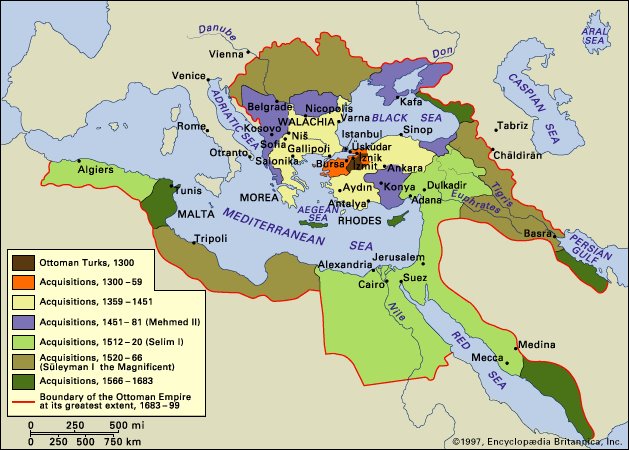
The map is from here.
2. The Byzantine Empire, circa 337-1453. This is the Eastern Roman Empire, if you want to be technical, because when Diocletian revamped Rome in the late third century, he split what had become somewhat unwieldy as a single political entity. Then Constantine built Constantinople at what is probably the best place to build a city in the history of mankind (New York might be second-best), and after the West fell, the East became the only Roman Empire, and turned more and more to Greece for their culture and language, hence "Byzantine" after the original Greek settlement on the shores of the Bosporus. The Byzantines are fascinating to me, because their city became the embodiment of empire: as long as Constantinople stood, the empire existed, even at the end, when that's all that was left. I find the emperors wonderful to read about: Justinian and his prostitute-turned-empress wife, Theodora; Heraclius, who finally defeated the Persians only to see his life's work destroyed by a new enemy, the Arabs; Irene, who ruled in 800 when Charlemagne was crowned in the West and may have spurred that decision, because everyone knew a woman couldn't rule an empire; Constantine VII Porphyrogenitus, who wrote a political treatise that gives us lots of information about the tenth century; Basil II, who has one of the best nicknames in history - "Bulgar-Slayer"; and Alexius, John, and Manuel Comnenus, who fought off the Crusaders and helped bring Byzantium its final glory days. Their relations with the West fascinate me, too, as does the Fourth Crusade, when the knights of Europe dared sack the city, earning the enmity of most right-thinking Christians. The final conflict against the Ottomans is interesting, too, as the Byzantines tried to mend fences with Rome against the wishes of their own populace. In a thousand-year history, there's very little that's boring about the Byzantines.

I found the map here, which shows the boundaries of the empire at different times in its history.
3. The Carolingian Empire, 800-843. Yes, it's a short-lived empire, and I suppose I could stretch it out, but the empire was established in 800 and was pretty much destroyed by the Treaty of Verdun in 843. I've written quite a bit about Charlemagne and his empire, so I'll just point out how neat the Carolingian Renaissance is and what a shockingly dynamic ruler Charlemagne really was.

Here is where I found the map.
4. The Roman Empire, 27 B. C.-A. D. 476. The granddaddy of them all! Okay, not really, but the oldest on this list. Rome set the stage for Europe, and as I dig European history, it's not surprising I like this empire so much. Rome is endlessly fascinating, from the early Julio-Claudians and the dominance of the Mediterranean (not to mention their involvement in that Jesus fiasco) to the second-century emperors like Trajan, Hadrian, and Marcus Aurelius to the third-century disasters to the renaissance under Diocletian and Constantine the Great. It's fun to read about the crazy emperors, but part of the interest in Rome is reading about how the fringe cultures and warriors reacted to Rome, from Zenobia in Palmyra to Boudicca in England to the later invasions of Goths and Vandals and whatnot. You could start studying Rome today and do so for the rest of your life and never run out of things to discover. It's quite keen.

5. The Umayyad/Abbasid Empires, 632-750; 758-1258. The early years of Islam are marked by astonishing expansion into northern Africa and east into Persia. This took place under the Umayyads, who were overthrown by the Abbasids in 750. I put the two together because the change in the caliphate was fairly smooth (accompanied by civil war and mass slaughter, to be sure, but once the Abbasids became ascendant, they simply took over). The Umayyads moved to Spain and set up a separate caliphate there, which led to a great flowering of culture on the peninsula. This time is Islam is fascinating, as the Muslims weren't sure what to do with all the possessions they suddenly found themselves with, and toward the end of the period, those tacky Crusaders showed up and upset the china in the Middle East, which unified a somewhat fractured religion against them. The greatest Abbasid caliph was Harun al-Rashid, the contemporary of Charlemagne and the template for the Arabian Nights saga. In 1258 the Mongols obliterated Baghdad and ended the Arab dominance of Islam, setting the stage for the Ottomans to take over the caliphate. It's very interesting to consider that despite Arabic being the official language of Islam and the thing that unites practitioners, there are deep nationalistic rivalries inside the religion, stretching back centuries. Studying Islam from this period helps illuminate what's going on now.

I stole the map from this site.
6. The Angevin Empire, 1154-1216. This ephemeral empire was formed mainly because Henry II of England married well. In 1152, Henry, the duke of Anjou, married Eleanor, duchess of Aquitaine. Eleanor had, two months earlier, divorced Louis VII of France because he was too effete for a man-lovin' woman like Eleanor (okay, who knows why they divorced - my reason is fun!). In 1154, to end England's civil war between King Stephen and Matilda, the daughter of King Henry I, Stephen agreed to name Henry (Matilda's son) as heir. When Stephen died, Henry became king of England. As he held the title of dozens of counties and duchies and whatnot in France and, through Eleanor, more vast land, he became the most powerful ruler in Europe. Hey, that was handy. Henry was the first Platagenet ruler, and with his wife, he had quite the blast, if the history books are to be believed. Of course, he had his best friend killed, but what are you going to do? He also pissed off Eleanor more than once, to the point where she helped her sons rebel against their father, and when Peter O'Toole - I mean, Henry - finally died, Richard and then John ruled after him. Richard, of course, is famous for going on crusade and making nice with Robin Hood in that Disney movie, while John is famous for being a lousy king and losing most of the "empire" that his father had created. It was never an "empire" in the sense of being one administrative state, as each of Henry's possessions had their own culture and governments, but it fun while it lasted!

From here is where I got the map.
7. The Holy Roman/Austrian/Austro-Hungarian Empire, 962-1918. The weirdest empire on this list, the Holy Roman Empire was technically founded by Otto the Great in 962, although ol' Otto tried to link his empire to Charlemagne's as a lot of people did back then. The empire was kept alive through several weak rulers, with only a few rising up to make any impression (Frederick Barbarossa, Frederick II) until the Habsburgs took over in the middle of the 15th century. Under Charles V (1519-1555) the empire reached the height of its power, but from then it declined. After Napoleon put it out of its misery in 1806, it transformed into a Habsburg-run Austrian empire, which became a joint monarchy with Hungary in 1867. It's an interesting empire to study, because it was such a lousy one. The emperor was rarely invested with any power, and unless he had a strong personality, he was helpless against the princes who elected him. Later, after Austria-Hungary became the center of the the empire, it became a baroque monstrosity, the most conservative state in turbulent times. Of course, it was the assassination of the heir to the throne of the empire that sparked the First World War. I have read more than one book that suggests the dismemberment of Austria-Hungary was the worst thing that could have happened for the Balkan nationalities. I don't know if I agree with that theory, but it's certainly something to chew on!


I found the second map here.
8. The German Empire, 1871-1918. I've always been keen on the German Empire, or "second Reich," as a certain Austrian dictator liked to call it. I read a biography of Otto von Bismarck years ago, and it was one of the better history books I've ever read. Plus, Napoleon III's wild ambitions and ruination in 1870-71 (see below) have also fascinated me (as has the Commune, but that's a whole different thing). When I was growing up, I used to read hardcover comics from England that had all kinds of neat stories in them (I lived in Germany, remember). One was about the Commune and how the French tried to get out of Paris during the siege. I guess it hooked me. Bismarck is an intriguing politician, and his relationship with both Wilhelm I and II is very interesting. Germany's escalation of the arms race in the late nineteenth and early twentieth centuries is one of the great tragedies of modern times. It wasn't all Germany's fault, of course, but Wilhelm II was such an odd popinjay that it makes World War I look inevitable. It's a much more interesting state than it gets credit for.

I need to point out that the map came from here.
9. The Second French Empire, 1852-1870. Speaking of the Germans, the emperor that the Germans defeated in the Franco-Prussian War, Napoleon III, ran this empire. He created it and then ran it into the ground. Napoleon, who was the first emperor's nephew, became the president after the 1848 revolution, and then decided to declare himself emperor. Under Napoleon III, France aggressively pursued more colonies in Africa, and Napoleon also tried to establish a client state in Mexico. This, of course, led to the celebration of Cinco de Mayo. Napoleon got in over his head when he declared war on Prussia, leading to utter defeat and his abdication. Napoleon, interestingly enough, was the first president and last monarch of France. The Second Empire is more interesting than the First, because the latter Napoleon was so much more of a schmuck than the original. The fact that he ruled France for 20 years is rather odd.
10. The Japanese Empire. Japan has always been an empire, but I'm keen on the Meiji Restoration era (from 1868) until the war. Japan adopted Western ways, expanded into the Pacific, and beat the snot out of everyone who got in their way. The Japanese did horrible things, especially in China, but the fact that they adapted so quickly to the modern world is very interesting. They wiped out the Russians in 1904, and in the Thirties took over the Pacific. What's most interesting is the way the West attempted to get around their natural racism to explain the rise of Japan. The Japanese war effort is also fascinating, because they could have easily won "their" war without involving the Americans. I like older Japanese history, too, but not as much as this period.
So those are my favorite empires. Empires are awfully swell. Does anyone out there have any favorite empires?
Labels: Empires, History, Top ten lists
posted by Greg | 4:54 PM
|
4 comments


